Migration policy, Media bias, Direct democracy (new papers)

Do Interest Groups Affect U.S. Immigration Policy?
Date: 2008-10-11
By: Prachi Mishra, Anna Maria Mayda, Giovanni Facchini
 
While anecdotal evidence suggests that interest groups play a key role in shaping immigration policy, there is no systematic empirical analysis of this issue. In this paper, we construct an industry-level dataset for the United States, by combining information on the number of temporary work visas with data on lobbying activity associated with immigration. We find robust evidence that both pro- and anti-immigration interest groups play a statistically significant and economically relevant role in shaping migration across sectors. Barriers to migration are lower in sectors in which business interest groups incur larger lobby expenditures and higher in sectors where labor unions are more important.
 
Media Bias and Influence: Evidence from Newspaper Endorsements
Date:2008-10
By: Brian G. Knight and Chun-Fang Chiang
 
This paper investigates the relationship between media bias and the influence of the media on voting in the context of newspaper endorsements. We first develop a simple econometric model in which voters choose candidates under uncertainty and rely on endorsements from better informed sources. Newspapers are potentially biased in favor of one of the candidates and voters thus rationally account for the credibility of any endorsements. Our primary empirical finding is that endorsements are influential in the sense that voters are more likely to support the recommended candidate after publication of the endorsement. The degree of this influence, however, depends upon the credibility of the endorsement. In this way, endorsements for the Democratic candidate from left-leaning newspapers are less influential than are endorsements from neutral or right-leaning newspapers, and likewise for endorsements for the Republican. These findings suggest that voters do rely on the media for information during campaigns but that the extent of this reliance depends upon the degree and direction of any bias.
 
Does Direct Democracy Reduce the Size of Government? New Evidence from Historical Data, 1890-2000
Date: 2008-10
By: Patricia Funk and Christina Gathmann
 
Using historical data for all Swiss cantons from 1890 to 2000, we estimate the causal effect of direct democracy on government spending. The main innovation in this paper is that we use fixed effects to control for unobserved heterogeneity and instrumental variables to address the potential endogeneity of institutions. We find that the budget referendum and lower costs to launch a voter initiative are effective tools in reducing canton level spending. However, we find no evidence that the budget referendum results in more decentralized government or a larger local government. Our instrumental variable estimates suggest that a mandatory budget referendum reduces the size of canton spending between 13 and 19 percent. A 1 percent lower signature requirement for the initiative reduces canton spending by up to 2 percent.
Keywords: Direct Democracy, Fiscal Policy, Switzerland
 

Myths about the 2008 crisis

Three economists at the Federal Reserve Bank of Minneapolis, Chari, Christiano and Kehoe, point out to Four Myths about the Financial Crisis of 2008 (it's a short paper and full of graphs). 
 
"Clearly, the United States and the world economy are undergoing a major financial crisis. Interbank borrowing and lending rates have risen to unprecedented levels relative to U.S. Treasury Bills. Several major financial institutions have failed. These real problems have also been associated with four widely-held myths about the nature of the financial crisis and the associated spillovers to the rest of the economy. The financial press and policymakers have made four claims about the nature of the crisis:
  1. Bank lending to nonfinancial corporations and individuals has declined sharply.
  2. Interbank lending is essentially nonexistent.
  3. Commercial paper issuance by nonfinancial corporations has declined sharply and rates have risen to unprecedented levels.
  4. Banks play a large role in channeling funds from savers to borrowers.
Here we examine these claims using data from the Federal Reserve Board. At least based on data up until October 8, 2008, we argue that all four claims are false."
 
So yes, it looks like capitalism will survive… On the other hand, a summary of the US real estate market adjustment process  is here.
 

Undecided voters

A funny but perhaps true flowchart from 235.com.

“The race for president between Barack Obama and John McCain has been going on for close to 17 years now, and yet still—still!—there are some voters who haven’t made up their minds about whom to vote for. Who are these undecideds, and what could possibly be going on in their tiny, tiny brains?”

The real estate bubble and the adjustment

A summary from Calculated Risk  (check out the link to see nice graphs).
 
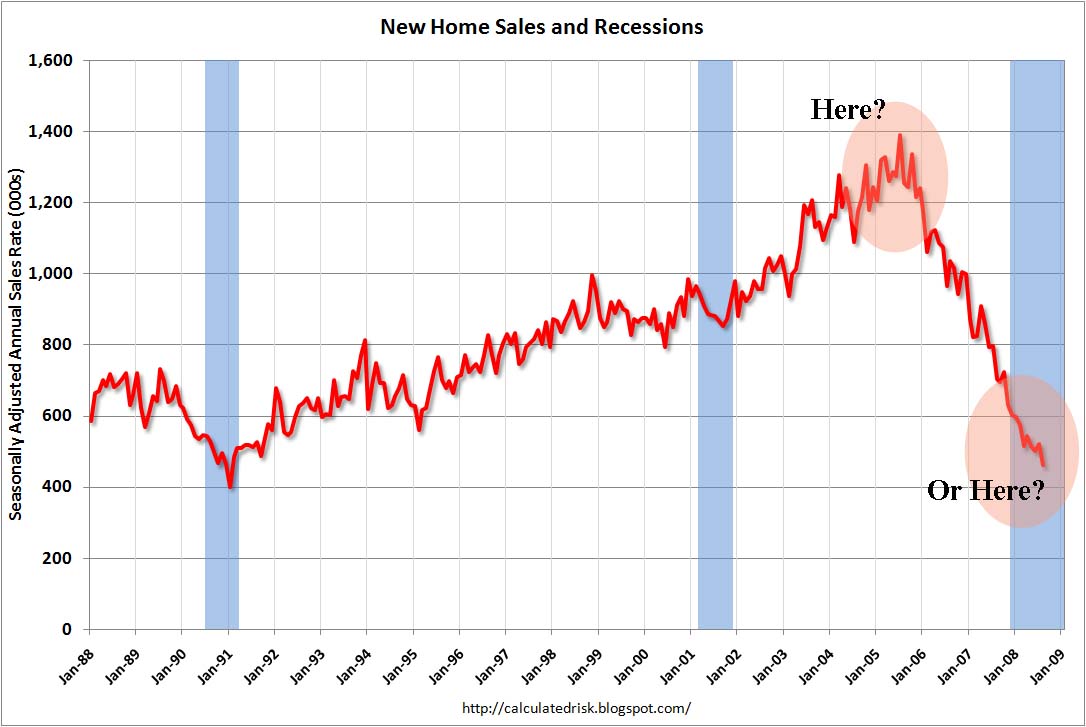
"I'm frequently asked if I'm more concerned today than I was in 2005. There are reasons for concern: the credit markets have seized up, many financial institutions are insolvent, consumer spending and investment in commercial real estate is starting to decline, export growth appears to be slowing, the unemployment rate is rising … and the economy is clearly in a recession. There are huge and scary downside risks today, but I'm actually more sanguine now than I was in 2005. If you think back to 2005, we were standing at the precipice, and there was no where to go but over the cliff.
 
Housing starts have collapsed by more than half since 2005. This decline seemed obvious and inevitable in 2005, and now most of the adjustment has already happened. Which was better for the economy looking forward? To be standing at the edge (in 2005) or to be much nearer the bottom in 2008?

Just like for housing starts, new home sales have collapsed by more than half since 2005. The good news is starts of single family homes built for sale have fallen below new home sales, and new home inventory is declining (although existing home inventory is still near record levels). Once again the bulk of the adjustment is now behind us.

(House price / income ratios are back to 2003 levels.)  Although I believe there are more price declines ahead (and therefore more homeowners with negative equity and more foreclosures), prices are much more reasonable today than in 2005.

The price adjustments were inevitable, and progress is being made."


Throw the bums out

A nice summary on voter irrationality from Larry Bartels:

“While voters are busy meting out myopic, ­simple-­minded rewards and punishments, political observers are often busy exaggerating the policy content of the voters’ verdicts. The prime example in American political history may be the watershed New Deal election of 1936. Having swept into office on a strong tide of economic discontent in 1932, Franklin Roosevelt initiated a series of wide-ranging new policies to cope with the Great Depression. According to the most authoritative political scholar of the era, V. O. Key, “The voters responded with a resounding ratification of the new thrust of governmental policy”—a stunning 46-state landslide that ushered in an era of Democratic electoral ­dominance.24

The 1936 election has become the most celebrated textbook case of ideological realignment in American history. However, a careful look at ­state-­by-­state voting patterns suggests that this resounding ratification of Roosevelt’s policies was strongly concentrated in the states that happened to enjoy robust income growth in the months leading up to the vote. Indeed, the apparent impact of ­short-­term economic conditions was so powerful that, if the recession of 1938 had occurred in 1936, Roosevelt probably would have been a ­one-­term ­president.25

It’s not only in the United States that the ­Depression-­era tendency to “throw the bums out” looks like something less than a rational policy judgment. In the United States, voters replaced Republicans with Democrats in 1932 and the economy improved. In Britain and Australia, voters replaced Labor governments with conservatives and the economy im­proved. In Sweden, voters replaced Conservatives with Liberals, then with Social Democrats, and the economy improved. In the Canadian agricultural province of Saskatchewan, voters replaced Conservatives with Socialists and the economy improved. In the adjacent agricultural province of Alberta, voters replaced a socialist party with a right-leaning party created from scratch by a charismatic radio preacher peddling a flighty ­share-­the-­wealth scheme, and the economy improved. In Weimar Germany, where economic distress was deeper and ­longer ­lasting, voters rejected all of the mainstream parties, the Nazis seized power, and the economy improved. In every case, the party that happened to be in power when the Depression eased went on to dominate politics for a decade or more thereafter. It seems far-fetched to imagine that all these contradictory shifts represented ­well-­considered ideological conversions. A more parsimonious interpretation is that voters ­simply—­and ­simple-­mindedly—­rewarded whoever happened to be in power when things got ­better.

Stupid? No, just human. And ­thus—­to borrow the title of another current ­best­seller, by behavioral economist Dan ­Ariely—­“predictably irrational.” That may be bad ­enough.”

GOTV and likely voters

Via realclearpolitics–This is what the the Washington Post wrote on Sunday:

Sen. Barack Obama’s campaign intends to avoid a (2004) repeat by building an
organization modeled in part on what Karl Rove used to engineer Bush’s victory:
a heavy reliance on local volunteers to pitch to their own neighbors,
micro-targeting techniques to identify persuadable independents and Republicans
using consumer data, and a focus on exurban and rural areas. But in scale and
ambition, the Obama organization goes beyond even what Rove built. The campaign
has used its record-breaking fundraising to open more than 700 offices in more
than a dozen battleground states, pay several thousand organizers and manage
tens of thousands more volunteers.

And this is what Gallup has to say regarding how this get out the vote strategy may affect its survey-weighting methods:

Likely Voter Estimates
“Obama’s current advantage is slightly less when estimating the preferences of likely voters, which Gallup will begin reporting on a regular basis between now and the election. Gallup is providing two likely voter estimates to take into account different turnout scenarios.
The first likely voter model is based on Gallup’s traditional likely voter assumptions,which determine respondents’ likelihood to vote based on how they answer questions about their current voting intention and past voting behavior. According to this model, Obama’s advantage over McCain is 50% to 46% in Oct. 9-11 tracking data.
The second likely voter estimate is a variation on the traditional model, but is only based on respondents’ current voting intention. This model would take into account increased voter registration this year and possibly higher turnout among groups that are traditionally less likely to vote, such as young adults and racial minorities (Gallup will continue to monitor and report on turnout indicators by subgroup between now and the election). According to this second likely voter model, Obama has a 51% to 45% lead over McCain. “
(Click here to see how the race currently breaks down by demographic subgroup.)

And for the “registered voters” sample, the figures are 50% Obama, 43% McCain. This means that the different weighting method leads to three different forecasts, with margins of victory ranging from a 4 to 7 percent lead in favor of Obama. With sampling errors of roughly 2%, the weighting method will be crucial in predicting heavily contested states such as Virginia.

Populist revolts

An historical vignette from Andrew Selgman’s blog

Mavericks of the past

Phil Klinkner writes:

History doesn’t repeat itself, the saying goes, but it does rhyme.

To me [Klinkner], the recent House defeat of the financial bailout bill echoes the defeat of the national sale tax in 1932. The Depression dried up federal revenues, so the Hoover administration proposed a national sales tax to raise money. Business and the leadership of both parties favored the bill, but the public was overwhelmingly opposed. Liberal Republican Fiorella LaGuardia led a bipartisan revolt against the bill. House Speaker John N. Garner (D-TX) actually left the speaker’s chair to go into the well and plead with his fellow Democrats to pass the bill. Garner normally had tight control on his party, but not this time. The bill was defeated 153-223.

In both cases, an unpopular Republican administration put forward a proposal to deal with an economic crisis, supported by the Democratic leadership in the House and the vast majority of the business community. Nonetheless, a bipartisan populist revolt sent it down to defeat.

And, Phil forgot to mention, James Garner was Maverick.

Y is not about X

Is everything about status? These are some sentences of wisdom from Robin Hanson at Overcoming Bias.

Clothes aren’t about Comfort
Marriage isn’t about Romance
Talk isn’t about Info
Charity isn’t about Helping
Church isn’t about God
Medicine isn’t about Health
Consulting isn’t about Advice
School isn’t about Learning
Research isn’t about Progress
Politics isn’t about Policy

High school students are easily engaged to elect class presidents, even though they have little idea what if any policies a class president might influence. Instead such elections are usually described as “popularity contests.” That is, theses elections are about which school social factions are to have higher social status. If a jock wins, jocks have higher status. If your girlfriend’s brother wins, you have higher status, etc. And the fact that you have a vote says that others should take you into account when forming coalitions – you are somebody.

Civics teachers talk as if politics is about policy, that politics is our system for choosing policies to deal with common problems. But as Tyler Cowen suggests, real politics seems to be more about who will be our leaders, and what coalitions will rise or fall in status as a result. Election media coverage focuses on characterizing the candidates themselves – their personalities, styles, friends, beliefs, etc. …As with high school class presidents, we care about policies mainly as clues to candidate character and affiliations. And to the extend we consider policies not tied to particular candidates, we mainly care about how policies will effect which kinds of people will be respected how much.

For example, we want nationalized medicine so poor sick folks will feel cared for, military actions so foreigners will treat us with respect, business deregulation as a sign of respect for hardworking businessfolk, official gay marriage as a sign we accept gays, and so on. This perspective explains why voters tend to prefer proportional representation, why many refuse to vote for any candidate when none have earned their respect…

Also related: Cowen’s relative status and ideology is here.

…and yes, perhaps this blog is not about “scholarly ideas” but about using whatever I think is interesting as a signal…

The mother of all bailouts

The draft of the LEGISLATIVE PROPOSAL FOR TREASURY AUTHORITY TO PURCHASE MORTGAGE-RELATED ASSETS in the US is so short even I could understand most of it. These are some excerpts of note (y algunos comentarios al vuelo):

Sec. 2. Purchases of Mortgage-Related Assets.

(a) Authority to Purchase.–The Secretary is authorized to purchase, and to make and fund commitments to purchase, on such terms and conditions as determined by the Secretary, mortgage-related assets from any financial institution having its headquarters in the United States.

(b) Necessary Actions.–The Secretary is authorized to take such actions as the Secretary deems necessary to carry out the authorities in this Act, including, without limitation: (1) appointing such employees as may be required to carry out the authorities in this Act and defining their duties; (2) entering into contracts, including contracts for services authorized by section 3109 of title 5, United States Code, without regard to any other provision of law regarding public contracts; (3) designating financial institutions as financial agents of the Government, and they shall perform all such reasonable duties related to this Act as financial agents of the Government as may be required of them; (4) establishing vehicles that are authorized, subject to supervision by the Secretary, to purchase mortgage-related assets and issue obligations; and (5) issuing such regulations and other guidance as may be necessary or appropriate to define terms or carry out the authorities of this Act.

Sec. 3. Considerations.

In exercising the authorities granted in this Act, the Secretary shall take into consideration means for–(1) providing stability or preventing disruption to the financial markets or banking system; and (2) protecting the taxpayer.

(Comparado con la detallada lista de “acciones necesarias”, los “consideraciones” son breves y ambiguas: ¿cómo se mide la estabilidad financiera y/o la protección del contribuyente?)

Sec. 4. Reports to Congress.

Within three months of the first exercise of the authority granted in section 2(a), and semiannually thereafter, the Secretary shall report to the Committees on the Budget, Financial Services, and Ways and Means of the House of Representatives and the Committees on the Budget, Finance, and Banking, Housing, and Urban Affairs of the Senate with respect to the authorities exercised under this Act and the considerations required by section 3.

(Nótese que, de ser aprobada esta iniciativa, el primer reporte de resultados se entregaría en diciembre–pasada la elección presidencial y antes de que Bush deje el poder.)

Sec. 6. Maximum Amount of Authorized Purchases.

The Secretary’s authority to purchase mortgage-related assets under this Act shall be limited to $700,000,000,000 outstanding at any one time.

(Nótese que el gobierno puede comprar o vender más de 700mil mdd, pero el “balance diario” nunca podrá exceder dicho monto.)

Sec. 8. Review.

Decisions by the Secretary pursuant to the authority of this Act are non-reviewable and committed to agency discretion, and may not be reviewed by any court of law or any administrative agency.

(Ojo, estamos hablando de poderes discrecionales sobre 700mil mdd.)

The complete proposal text is here.

Taleb on the Limits of Statistics

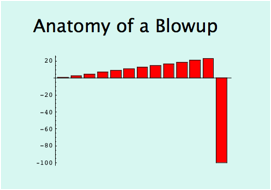
Taleb’s classical metaphor: “A turkey is fed for a 1000 days—every days confirms to its statistical department that the human race cares about its welfare ‘with increased statistical significance’. On the 1001st day, the turkey has a surprise.”

Some quotable quotes from Taleb’s essay:

“Statistical and applied probabilistic knowledge is the core of knowledge; statistics is what tells you if something is true, false, or merely anecdotal; it is the “logic of science”; it is the instrument of risk-taking; it is the applied tools of epistemology; you can’t be a modern intellectual and not think probabilistically—but… let’s not be suckers. The problem is much more complicated than it seems to the casual, mechanistic user who picked it up in graduate school. Statistics can fool you. In fact it is fooling your government right now.

“By the “narrative fallacy” the turkey economics department will always manage to state, before thanksgivings that “we are in a new era of safety”, and back-it up with thorough and “rigorous” analysis. And Professor Bernanke indeed found plenty of economic explanations—what I call the narrative fallacy—with graphs, jargon, curves, the kind of facade-of-knowledge that you find in economics textbooks. This is the find of glib, snake-oil facade of knowledge—even more dangerous because of the mathematics. (…) I have nothing against economists: you should let them entertain each others with their theories and elegant mathematics, and help keep college students inside buildings. But beware: they can be plain wrong, yet frame things in a way to make you feel stupid arguing with them.

What Is Wise To Do (Or Not Do) In The Fourth Quadrant

(NB: The 4th quadrant basically refers to heavy-tailed or unknown probability distributions with complex or nonlinear payoffs)

1) Avoid Optimization, Learn to Love Redundancy. Psychologists tell us that getting rich does not bring happiness—if you spend it. But if you hide it under the mattress, you are less vulnerable to a black swan. (…) Biological systems—those that survived millions of years—include huge redundancies. (…) Historically populations tended to produced around 4-12 children to get to the historical average of ~2 survivors to adulthood.

2) Avoid prediction of remote payoffs—though not necessarily ordinary ones. Payoffs from remote parts of the distribution are more difficult to predict than closer parts. A general principle is that, while in the first three quadrants you can use the best model you can find, this is dangerous in the fourth quadrant: no model should be better than just any model.

3) Beware the “atypicality” of remote events. There is a sucker’s method called “scenario analysis” and “stress testing”—usually based on the past (or some “make sense” theory).

4) Time. It takes much, much longer for a times series in the Fourth Quadrant to reveal its property. At the worst, we don’t know how long. Things that have worked for a long time are preferable—they are more likely to have reached their ergodic states.

5) Beware Moral Hazard. Is optimal to make series of bonuses betting on hidden risks in the Fourth Quadrant, then blow up and write a thank you letter.

6) Metrics. Conventional metrics based on type 1 randomness don’t work. Words like “standard deviation” are not stable and does not measure anything in the Fourth Quadrant. 70-90% of the Kurtosis in Oil, SP500, Silver, UK interest rates, Nikkei, US deposit rates, sugar, and the dollar/yet currency rate come from 1 day in the past 40 years.

What makes people vote republican? (morality vs. policies)

Aunque estoy poco capacitado para evaluar la originalidad del argumento, este ensayo me parece bastante interesante.  If he is right, are (some sort of) political scientists also missing an important point?  Saludos!
 
WHAT MAKES PEOPLE VOTE REPUBLICAN?
By Jonathan Haidt
What makes people vote Republican? Why in particular do working class and rural Americans usually vote for pro-business Republicans when their economic interests would seem better served by Democratic policies? We psychologists have been examining the origins of ideology ever since Hitler sent us Germany's best psychologists, and we long ago reported that strict parenting and a variety of personal insecurities work together to turn people against liberalism, diversity, and progress. But now that we can map the brains, genes, and unconscious attitudes of conservatives, we have refined our diagnosis: conservatism is a partially heritable personality trait that predisposes some people to be cognitively inflexible, fond of hierarchy, and inordinately afraid of uncertainty, change, and death. People vote Republican because Republicans offer "moral clarity"—a simple vision of good and evil that activates deep seated fears in much of the electorate. Democrats, in contrast, appeal to reason with their long-winded explorations of policy options for a complex world.
 
Diagnosis is a pleasure. It is a thrill to solve a mystery from scattered clues, and it is empowering to know what makes others tick. In the psychological community, where almost all of us are politically liberal, our diagnosis of conservatism gives us the additional pleasure of shared righteous anger. We can explain how Republicans exploit frames, phrases, and fears to trick Americans into supporting policies (such as the "war on terror" and repeal of the "death tax") that damage the national interest for partisan advantage.
 
But with pleasure comes seduction, and with righteous pleasure comes seduction wearing a halo. Our diagnosis explains away Republican successes while convincing us and our fellow liberals that we hold the moral high ground. Our diagnosis tells us that we have nothing to learn from other ideologies, and it blinds us to what I think is one of the main reasons that so many Americans voted Republican over the last 30 years: they honestly prefer the Republican vision of a moral order to the one offered by Democrats. To see what Democrats have been missing, it helps to take off the halo, step back for a moment, and think about what morality really is.
(…)
If Democrats want to understand what makes people vote Republican, they must first understand the full spectrum of American moral concerns. They should then consider whether they can use more of that spectrum themselves. The Democrats would lose their souls if they ever abandoned their commitment to social justice, but social justice is about getting fair relationships among the parts of the nation. This often divisive struggle among the parts must be balanced by a clear and oft-repeated commitment to guarding the precious coherence of the whole. America lacks the long history, small size, ethnic homogeneity, and soccer mania that holds many other nations together, so our flag, our founding fathers, our military, and our common language take on a moral importance that many liberals find hard to fathom.

Unity is not the great need of the hour, it is the eternal struggle of our immigrant nation. The three Durkheimian foundations of ingroup, authority, and purity are powerful tools in that struggle. Until Democrats understand this point, they will be vulnerable to the seductive but false belief that Americans vote for Republicans primarily because they have been duped into doing so.

 
JONATHAN HAIDT is Associate Professor of Psychology at the University of Virginia, where he does research on morality and emotion and how they vary across cultures. He is the author of The Happiness Hypothesis: Finding Modern Truth in Ancient Wisdom.
 
El ensayo completo (y un debate en torno al mismo) están aqui:
 

Obama vs. McCain

A few notable paragraphs of Obama speech at the Democratic National Convention (August 28th, 2008).  His criticism of McCain is a bit more nuanced than Palin–because you don't want to go ballistic with McCain the hero.

"Tonight, I say to the American people, to Democrats and Republicans and Independents across this great land – enough!  This moment – this election – is our chance to keep, in the 21st century, the American promise alive.  Because next week, in Minnesota, the same party that brought you two terms of George Bush and Dick Cheney will ask this country for a third.  And we are here because we love this country too much to let the next four years look like the last eight.  On November 4th, we must stand up and say: "Eight is enough."

Now let there be no doubt.  The Republican nominee, John McCain, has worn the uniform of our country with bravery and distinction, and for that we owe him our gratitude and respect.  And next week, we'll also hear about those occasions when he's broken with his party as evidence that he can deliver the change that we need. But the record's clear: John McCain has voted with George Bush ninety percent of the time.  Senator McCain likes to talk about judgment, but really, what does it say about your judgment when you think George Bush has been right more than ninety percent of the time?  I don't know about you, but I'm not ready to take a ten percent chance on change.

The truth is, on issue after issue that would make a difference in your lives – on health care and education and the economy – Senator McCain has been anything but independent.  He said that our economy has made "great progress" under this President.  He said that the fundamentals of the economy are strong.  And when one of his chief advisors – the man who wrote his economic plan – was talking about the anxiety Americans are feeling, he said that we were just suffering from a "mental recession," and that we've become, and I quote, "a nation of whiners."
(…)
Now, I don't believe that Senator McCain doesn't care what's going on in the lives of Americans.  I just think he doesn't know.  Why else would he define middle-class as someone making under five million dollars a year?  How else could he propose hundreds of billions in tax breaks for big corporations and oil companies but not one penny of tax relief to more than one hundred million Americans?  How else could he offer a health care plan that would actually tax people's benefits, or an education plan that would do nothing to help families pay for college, or a plan that would privatize Social Security and gamble your retirement?  It's not because John McCain doesn't care.  It's because John McCain doesn't get it.

For over two decades, he's subscribed to that old, discredited Republican philosophy – give more and more to those with the most and hope that prosperity trickles down to everyone else.  In Washington, they call this the Ownership Society, but what it really means is – you're on your own.  Out of work?  Tough luck.  No health care?  The market will fix it.  Born into poverty?  Pull yourself up by your own bootstraps – even if you don't have boots.  You're on your own.

Well it's time for them to own their failure.  It's time for us to change America."


Palin goes negative

I really like (some of) the smears and negative campaigning that we have heard in both the Democratic and Republican convention.  If nothing else, they make it easy for even the most undecided or uninformed voters to contrast and ponder each candidate's strenghts and weaknesses.  Obviously, you have to hear both sides. VP candidates are the official attack dogs in presidential campaigns. These two are excerpts from Sarah Palin speech at the RNC that I particularly liked:
 
"Before I became governor of the great state of Alaska, I was mayor of my hometown. And since our opponents in this presidential election seem to look down on that experience, let me explain to them what the job involves. I guess a small-town mayor is sort of like a "community organizer," except that you have actual responsibilities. I might add that in small towns, we don't quite know what to make of a candidate who lavishes praise on working people when they are listening, and then talks about how bitterly they cling to their religion and guns when those people aren't listening."
 
"I've noticed a pattern with our opponent. Maybe you have, too. We've all heard his dramatic speeches before devoted followers. And there is much to like and admire about our opponent. But listening to him speak, it's easy to forget that this is a man who has authored two memoirs but not a single major law or reform — not even in the state senate. This is a man who can give an entire speech about the wars America is fighting, and never use the word "victory" except when he's talking about his own campaign. But when the cloud of rhetoric has passed … when the roar of the crowd fades away … when the stadium lights go out, and those Styrofoam Greek columns are hauled back to some studio lot — what exactly is our opponent's plan? What does he actually seek to accomplish, after he's done turning back the waters and healing the planet? The answer is to make government bigger…"
 
Coming soon: my fav excerpts from the DNC speeches…