The mother of all bailouts

The draft of the LEGISLATIVE PROPOSAL FOR TREASURY AUTHORITY TO PURCHASE MORTGAGE-RELATED ASSETS in the US is so short even I could understand most of it. These are some excerpts of note (y algunos comentarios al vuelo):

Sec. 2. Purchases of Mortgage-Related Assets.

(a) Authority to Purchase.–The Secretary is authorized to purchase, and to make and fund commitments to purchase, on such terms and conditions as determined by the Secretary, mortgage-related assets from any financial institution having its headquarters in the United States.

(b) Necessary Actions.–The Secretary is authorized to take such actions as the Secretary deems necessary to carry out the authorities in this Act, including, without limitation: (1) appointing such employees as may be required to carry out the authorities in this Act and defining their duties; (2) entering into contracts, including contracts for services authorized by section 3109 of title 5, United States Code, without regard to any other provision of law regarding public contracts; (3) designating financial institutions as financial agents of the Government, and they shall perform all such reasonable duties related to this Act as financial agents of the Government as may be required of them; (4) establishing vehicles that are authorized, subject to supervision by the Secretary, to purchase mortgage-related assets and issue obligations; and (5) issuing such regulations and other guidance as may be necessary or appropriate to define terms or carry out the authorities of this Act.

Sec. 3. Considerations.

In exercising the authorities granted in this Act, the Secretary shall take into consideration means for–(1) providing stability or preventing disruption to the financial markets or banking system; and (2) protecting the taxpayer.

(Comparado con la detallada lista de “acciones necesarias”, los “consideraciones” son breves y ambiguas: ¿cómo se mide la estabilidad financiera y/o la protección del contribuyente?)

Sec. 4. Reports to Congress.

Within three months of the first exercise of the authority granted in section 2(a), and semiannually thereafter, the Secretary shall report to the Committees on the Budget, Financial Services, and Ways and Means of the House of Representatives and the Committees on the Budget, Finance, and Banking, Housing, and Urban Affairs of the Senate with respect to the authorities exercised under this Act and the considerations required by section 3.

(Nótese que, de ser aprobada esta iniciativa, el primer reporte de resultados se entregaría en diciembre–pasada la elección presidencial y antes de que Bush deje el poder.)

Sec. 6. Maximum Amount of Authorized Purchases.

The Secretary’s authority to purchase mortgage-related assets under this Act shall be limited to $700,000,000,000 outstanding at any one time.

(Nótese que el gobierno puede comprar o vender más de 700mil mdd, pero el “balance diario” nunca podrá exceder dicho monto.)

Sec. 8. Review.

Decisions by the Secretary pursuant to the authority of this Act are non-reviewable and committed to agency discretion, and may not be reviewed by any court of law or any administrative agency.

(Ojo, estamos hablando de poderes discrecionales sobre 700mil mdd.)

The complete proposal text is here.
Taleb on the Limits of Statistics

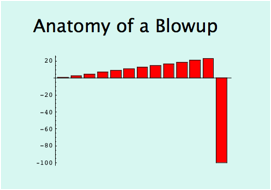
Taleb’s classical metaphor: “A turkey is fed for a 1000 days—every days confirms to its statistical department that the human race cares about its welfare ‘with increased statistical significance’. On the 1001st day, the turkey has a surprise.”

Some quotable quotes from Taleb’s essay:

“Statistical and applied probabilistic knowledge is the core of knowledge; statistics is what tells you if something is true, false, or merely anecdotal; it is the “logic of science”; it is the instrument of risk-taking; it is the applied tools of epistemology; you can’t be a modern intellectual and not think probabilistically—but… let’s not be suckers. The problem is much more complicated than it seems to the casual, mechanistic user who picked it up in graduate school. Statistics can fool you. In fact it is fooling your government right now.

“By the “narrative fallacy” the turkey economics department will always manage to state, before thanksgivings that “we are in a new era of safety”, and back-it up with thorough and “rigorous” analysis. And Professor Bernanke indeed found plenty of economic explanations—what I call the narrative fallacy—with graphs, jargon, curves, the kind of facade-of-knowledge that you find in economics textbooks. This is the find of glib, snake-oil facade of knowledge—even more dangerous because of the mathematics. (…) I have nothing against economists: you should let them entertain each others with their theories and elegant mathematics, and help keep college students inside buildings. But beware: they can be plain wrong, yet frame things in a way to make you feel stupid arguing with them.

What Is Wise To Do (Or Not Do) In The Fourth Quadrant

(NB: The 4th quadrant basically refers to heavy-tailed or unknown probability distributions with complex or nonlinear payoffs)

1) Avoid Optimization, Learn to Love Redundancy. Psychologists tell us that getting rich does not bring happiness—if you spend it. But if you hide it under the mattress, you are less vulnerable to a black swan. (…) Biological systems—those that survived millions of years—include huge redundancies. (…) Historically populations tended to produced around 4-12 children to get to the historical average of ~2 survivors to adulthood.

2) Avoid prediction of remote payoffs—though not necessarily ordinary ones. Payoffs from remote parts of the distribution are more difficult to predict than closer parts. A general principle is that, while in the first three quadrants you can use the best model you can find, this is dangerous in the fourth quadrant: no model should be better than just any model.

3) Beware the “atypicality” of remote events. There is a sucker’s method called “scenario analysis” and “stress testing”—usually based on the past (or some “make sense” theory).

4) Time. It takes much, much longer for a times series in the Fourth Quadrant to reveal its property. At the worst, we don’t know how long. Things that have worked for a long time are preferable—they are more likely to have reached their ergodic states.

5) Beware Moral Hazard. Is optimal to make series of bonuses betting on hidden risks in the Fourth Quadrant, then blow up and write a thank you letter.

6) Metrics. Conventional metrics based on type 1 randomness don’t work. Words like “standard deviation” are not stable and does not measure anything in the Fourth Quadrant. 70-90% of the Kurtosis in Oil, SP500, Silver, UK interest rates, Nikkei, US deposit rates, sugar, and the dollar/yet currency rate come from 1 day in the past 40 years.