Comparative trends in US presidential elections 2000 to 2008

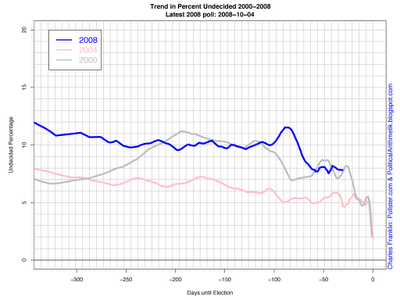
In the final days before the election, pundits and the media will claim that the race “is tightening” and that “you never know what may happen”. To be sure, there is never a 100% certainty, yet I believe the financial crisis pretty much settled the 2008 election (I’ll let you decide to what extent the crisis was a surprise event). Any supporting evidence? This is what Charles Franklin (Univ of Wisconsin, Madison) wrote on Oct 6th, 2008, almost a month before election day:

“The 2008 campaign had not seen a really big move in preferences until the financial crisis hit three weeks ago today. Since that time, the Obama-McCain margin has shifted almost 9 points in Obama’s favor, converting a small McCain lead into a substantial Obama advantage. This swing reversed the gains McCain made with the Republican convention and the week after during which he picked up about 4 points and took the lead for the first time since March.
I wrote earlier that we had not seen a move in 2008 as large as ones we saw in both 2000 and 2004. That is no longer true of 2004, though the current run is not yet as large as the one Gore mounted in 2000.
The Bush counter-assault in 2000, after Gore’s surge, was almost eight points, and began at almost the same point in the campaign, about 57 days out. Voters are making up their minds at about the same rate as they did in 2000. If this year follows that pattern, look for some serious decision making over the next two weeks.

These are Franklin’s critical graphs:

Sam Wang (Princeton Election Consortium) links to the (even clearer) electoral vote predictions for 2004 here, and for 2008 here. He also commented that:

In 2004, candidate game-shifting events were:

7/26: Democratic convention
8/5-31: Swift Boat Veterans for Truth ad campaign
8/30: Republican convention
9/30: Debate #1
The other debates (10/8, 10/13) had no measurable effect.
In 2008, the game-shifting events have been:

6/7: Hillary Clinton concedes
8/1: McCain’s “Celebrity” ad campaign
8/25-9/5: Both conventions and McCain announcement of Palin
9/11-12: Palin on ABC News w/Charlie Gibson, McCain on “The View”
9/26: Obama-McCain debate #1
All of these events were shortly followed by swings.

Public funding and the 2008 election

This is George F. Will, in today's Washington Post, on some of the campaign finance lessons from the 2008 presidential election:
 
Call him John the careless
Thursday, October 30, 2008
 
(…) McCain revived a familiar villain — "huge amounts" of political money — when Barack Obama announced that he had received contributions of $150 million in September. "The dam is broken," said McCain, whose constitutional carelessness involves wanting to multiply impediments to people who want to participate in politics by contributing to candidates — people such as the 632,000 first-time givers to Obama in September.

Why is it virtuous to erect a dam of laws to impede the flow of contributions by which citizens exercise their First Amendment right to political expression? "We're now going to see," McCain warned, "huge amounts of money coming into political campaigns, and we know history tells us that always leads to scandal." The supposedly inevitable scandal, which supposedly justifies preemptive government restrictions on Americans' freedom to fund the dissemination of political ideas they favor, presumably is that Obama will be pressured to give favors to his September givers. The contributions by the new givers that month averaged $86.

One excellent result of this election cycle is that public financing of presidential campaigns now seems sillier than ever. The public has always disliked it: Voluntary and cost-free participation, using the check-off on the income tax form, peaked at 28.7 percent in 1980 and has sagged to 9.2 percent. The Post, which is melancholy about the system's parlous condition, says there were three reasons for creating public financing: to free candidates from the demands of fundraising, to level the playing field and "to limit the amount of money pouring into presidential campaigns." The first reason is decreasingly persuasive because fundraising is increasingly easy because of new technologies such as the Internet. The second reason is, the Supreme Court says, constitutionally impermissible. Government may not mandate equality of resources among political competitors who earn different levels of voluntary support. As for the third reason — "huge amounts" (McCain) of money "pouring into" (The Post) presidential politics — well:

The Center for Responsive Politics calculates that, by Election Day, $2.4 billion will have been spent on presidential campaigns in the two-year election cycle that began in January 2007, and an additional $2.9 billion will have been spent on 435 House and 35 Senate contests. This $5.3 billion is a billion less than Americans will spend this year on potato chips.