Candidaturas independientes 2012

Hoy se discutió en el TEPJF el caso Clouthier y el de otros candidatos independientes (ie, no postulados por algún partido político) a la presidencia de la República.

Se trata de los “juicios para la protección de los derechos político-electorales del ciudadano (JDC) 612, 624, 639 y 659 todos de este año promovidos por Manuel Jesús Clouthier Carrillo, Alejandro Daniel Garza Montes de Oca, Héctor Montoya Fernández y Edmundo Sánchez Aguilar, respectivamente, a fin de controvertir el acuerdo emitido por el Consejo General del IFE por el cual negó a los enjuiciantes el registro de candidatos ciudadanos al cargo de Presidente Constitucional de los Estados Unidos Mexicanos.” Por mayoría de 4 vs. 2, la Sala Superior del TEPJF confirmó el acuerdo del Consejo General del IFE por el cual se negó el registro como candidatos independientes.

Aquí encontrarán una nota informativa del mismo TEPJF. Aquí el boletín de prensa.

Aquí encontrarán los links a las sentencias (en cuanto estén disponibles en línea).

En la misma sesión, el TEPJF confirmó la legalidad de la cancelación y sustitución de candidatos a cargos de diputados federales y senadores, por el principio de mayoría relativa, en cumplimiento a la cuota de género según el primer párrafo del Artículo 219 del COFIPE.

…more later…
Melissa Dell en el CIDE

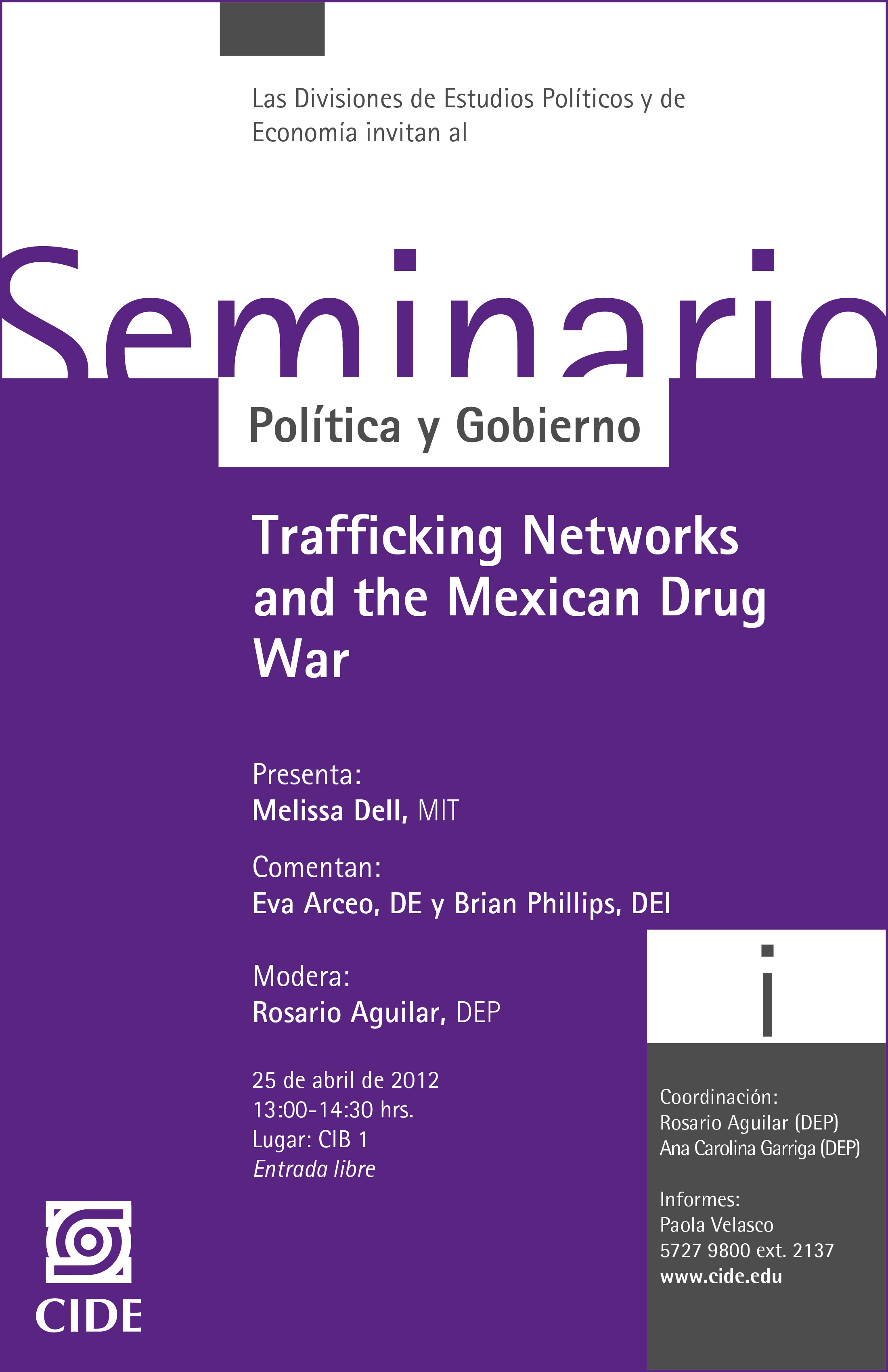
Este miércoles a la 1pm, la División de Estudios Políticos y la División de Economía del CIDE invitan al seminario:

Trafficking Networks and the Mexican Drug War (appendix), de Melissa Dell (MIT).

Abstract: Drug trade-related violence has escalated dramatically in Mexico during the past five years, claiming 40,000 lives and raising concerns about the capacity of the Mexican state to monopolize violence. This study examines how drug traffickers’ economic objectives influence the direct and spillover effects of Mexican policy towards the drug trade. By exploiting variation from close mayoral elections and a network model of drug trafficking, the study develops three sets of results. First, regression discontinuity estimates show that drug trade-related violence in a municipality increases substantially after the close election of a mayor from the conservative National Action Party (PAN), which has spearheaded the war on drug trafficking. This violence consists primarily of individuals involved in the drug trade killing each other. The empirical evidence suggests that the violence reflects rival traffickers’ attempts to wrest control of territories after crackdowns initiated by PAN mayors have challenged the incumbent criminals. Second, the study accurately predicts diversion of drug traffic following close PAN victories. It does this by estimating a model of equilibrium routes for trafficking drugs across the Mexican road network to the U.S. When drug traffic is diverted to other municipalities, drug trade-related violence in these municipalities increases. Moreover, female labor force participation and informal sector wages fall, corroborating qualitative evidence that traffickers extort informal sector producers. Finally, the study uses the trafficking model and estimated spillover effects to examine the allocation of law enforcement resources. Overall, the results demonstrate how traffickers’ economic objectives and constraints imposed by the routes network affect the policy outcomes of the Mexican Drug War.

Comentan: Eva Arceo (DE) y Brian Phillips (DEI)
Modera: Rosario Aguilar (DEP)
Fecha y lugar: 25 de abril de 2012, 1:00-2:30 pm, Sala CIB 1.

Aquí encontrarán más papers de Melissa Dell.

Beyond incumbency disadvantage – MPSA 2012

Esta semana Joy Langston y yo estaremos en Chicago para presentar la versión más reciente de nuestro trabajo sobre cuotas de género y elecciones legislativas en México.

El miércoles 10 de abril participaremos en el comparative politics workshop de la Universidad de Chicago. Y el jueves 11 participaremos en el panel sobre “Gender Quotas and Women’s Representation” de la Midwest Political Science Association Conference 2012. El programa preliminar y muchos de los papers están disponibles aquí.

Beyond the Incumbency Disadvantage: Why More Women Do Not Win Legislative Seats”

Abstract. Why women politicians tend to have more difficulty winning a legislative seat coming from SMD districts than their PR counterparts, even with gender quotas? Some of the common answers given, such as male incumbency advantage and voter bias, are not as complete as one might believe. Mexico is an excellent case to study this phenomenon because consecutive reelection is prohibited, so that incumbency alone cannot explain the gender gap in SMD races. Thus, we focus on a key difference between SMD and closed list PR, which is vigorous, local campaigning.
We analyze the impact of candidate background or experience on the vote shares and the probability of success of a sample of 600 candidates and found that the experience premium is larger than the gender gap in electoral returns. To understand why this is the case, we used interviews and found that men and women do not appear to campaign differently, whereas winners and losers do. This is because campaign success in Mexican SMDs depends heavily on the ability of the deputy hopeful to procure local political brokers who are able to control or mobilize blocks of voters, and candidate’s prior experience helps create a valuable reputation for access to government services that these brokers need to deliver selective goods to their followers.