Immigrants and their Homelands

This friday, Covadonga Meseguer and I are attending an all day workshop at UCLA.  This is the program:

“Immigrants and their Homelands: Engagements, Impacts, Responses”

UCLA,  April 30th 2010

PANEL I

Leticia Calderón Chelius (Instituto Mora) “Uses and abuses of the social construction of the Mexican diaspora”
Lauren Duquette (Chicago) “Migrant Collective Remittances: Transforming Public Works, Local Governance, and State-Society Relations in Mexico”
Natasha Iskander (NYU) “Moroccan migrants as captains of industry: Remittances, Financial Engagement, and La Banque Centrale Populaire”
Jean-Michel Lafleur (University of Liege) “Bolivia’s first experience of external voting: comparing the profile of emigrant voters in New York, Sao Paulo, Buenos Aires and Madrid”

Commentator: David Fitzgerald (UCSD)

PANEL II

Katrina Burgess (Tufts) “Migrant Associations and Democratic Accountability in Mexico”
Clarisa Perez-Armendariz (Bates College) “Trans-state communication and political learning”
Roger Waldinger (UCLA)  “The Limits of Engagement: Mexico and its Diaspora”

Commentator: Roberto Suro (USC)

PANEL III

Jeronimo Cortina (Houston), “Beyond the Money: The Impact of International Migration on Children’s Life Satisfaction – An Initial Assessment”
Jonathan Hiskey (Vanderbilt) “Migration Connections and Democracy in Latin America”
Covadonga Meseguer and Javier Aparicio (CIDE) “The Political Economy of Collective Remittances: The Mexican 3×1  Program for Migrants”

Commentator: Jorge Bravo (UCLA)
Chicago / MPSA 2010

This weekend I will be attending the Midwest Political Science Association Conference, in Chicago 22-25 April, 2010. You can find the program and some papers here. These are the abstracts of the papers that we will deliver at the conference.

Subsidized democracy? The effect of public funding to political parties in electoral competitiveness

Javier Aparicio and Jacaranda Pérez (IFE)

[Session 22-19 Comparative Electoral Analysis. Saturday, April 24 10:25 am]

Public funding to political parties has been adopted in a large number of democracies over the last several decades. Public funding seeks two major goals: 1) to level the playing field in electoral races, which should make elections more competitive; and 2) to reduce the entry costs for new political parties, which should enhance the representativeness of the electoral system.  However, there is scant evidence on whether or not any of these objectives are actually achieved. Using a panel dataset of national elections in OECD countries over the 1945 to 2008 period, we estimate the effect of public funding on the competitiveness of both parliamentary and presidential elections.  Our results indicate that public funding is associated with narrower margins of victory and a larger effective number of political parties.  On the other hand, public funding may be associated with lower turnout levels.

The Mexican Supreme Court: Judicial Activism in New Constitutional Courts

Jenny Guardado (NYU) and Javier Aparicio

[Session 3-24 Political Institutions in Contemporary Mexico. Saturday, April 24 12:45 pm]

Under what conditions do newly established constitutional courts exercise their judicial review powers? Recent studies of judicial decision-making have ignored the political process leading to the ling of a case, which creates sample selection problems: Are constitutional courts more active because they receive more cases that are “likely to succeed”, or because the political conditions of each case have a role in the court’s final rulings? We address this issue by exploiting the longitudinal variation in a novel dataset of all constitutional cases presented by sub-national actors to the Mexican Supreme Court from 1995 to 2005. We use sample selection and propensity score matching models to estimate the likelihood of a positive ruling from the court, conditional on the factors that led to the filing of a case in the first place. Our results indicate that sub-national political pluralism is associated with a higher likelihood of judicial activity. Specifically, the Court’s rulings are more likely to change the status-quo when political fragmentation or competition is higher. Moreover, we find that this effect varies depending on the likelihood of presenting a case. Finally, we find that the partisanship of the actors involved have a lesser impact.

Reforma política, sistema electoral y Congreso

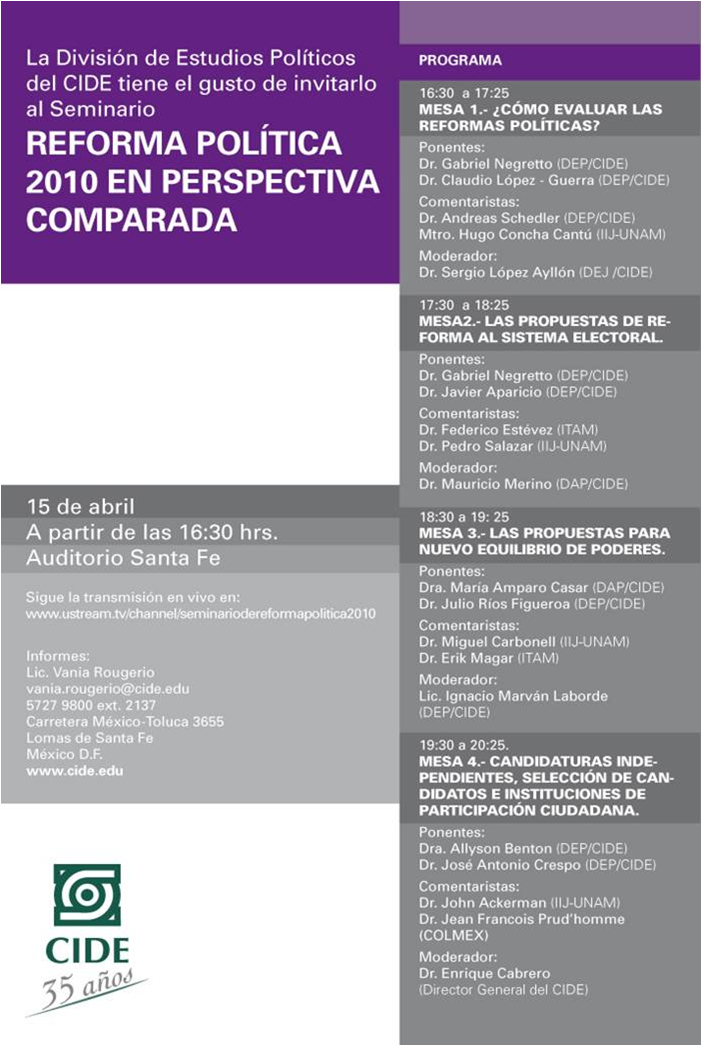
Esta es la presentación powerpoint del trabajo que Javier Márquez y yo preparamos para el Seminario “Reforma Política en Perspectiva Comparada” organizado por el CIDE el 15 de abril pasado. El seminario fue transmitido online y pueden verlo aquí (mi intervención comienza en el minuto 1:34 y dura 15 minutos).

Nuestra ponencia fue sobre: “Reforma política y sistema electoral: tamaño del congreso, redistritación y umbral de representación en México”. El texto aún está en proceso pero podemos adelantar algunas de las conclusiones:

  1. Una reducción de 100 curules RP tiene efectos marginales en el tamaño relativo de las bancadas.
  2. La redistritación MR puede tener efectos significativamente mayores: alteraría tanto el sesgo mayoritario como el sesgo partidista del sistema.
  3. El sesgo mayoritario de la Cámara se debe, sobre todo, a que no existe un mecanismo compensatorio: las curules RP se asignan independientemente del éxito o fracaso en la pista MR.
  4. El tope de sobrerrepresentación produce efectos no lineales en la asignación de curules: más votos no necesariamente se traducen en más curules (y viceversa).
  5. Un esquema RP con listas estatales de diferente magnitud introduciría un sesgo mayoritario en las bancadas estatales (inversamente proporcional a su población).
  6. Aumentar el umbral de representación aumenta el sesgo mayoritario del sistema electoral y disminuye el número efectivo de partidos en el Congreso. Pero beneficia a todo partido que haya sido penalizado por el tope de sobrerrepresentación.

Y algunas alternativas que podrían considerarse son:

  1. Al igual que el tope de sobrerrepresentación, una “claúsula de gobernabilidad” produce efectos no lineales: otorga más curules de las obtenidas con votos y castiga al resto de los partidos. Este tipo de esquemas son raramente vistos en el mundo.
  2. El sistema electoral podría ser igual o más proporcional que ahora si:
  • Aumenta el número de distritos MR (menor tamaño de distrito produce más proporcionalidad).
  • Aumenta el número de curules RP con listas de magnitud suficientemente  grande.
  • Se introduce un “mecanismo compensatorio” en la asignación de curules RP: si un partido tiene mucho éxito en la pista MR, recibe menos curules RP, y viceversa.
  • Se permite una boleta para MR y otra para RP, de modo que el split ticket voting disminuya la sobrerrepresentación del partido con mayoría relativa.