XXVI Diplomado en Análisis Político Estratégico

El próximo viernes 22 de febrero de 2013 inicia el XXVI Diplomado en Análsis Político Estratégico del CIDE, coordinado por Claudio López-Guerra y Javier Aparicio.
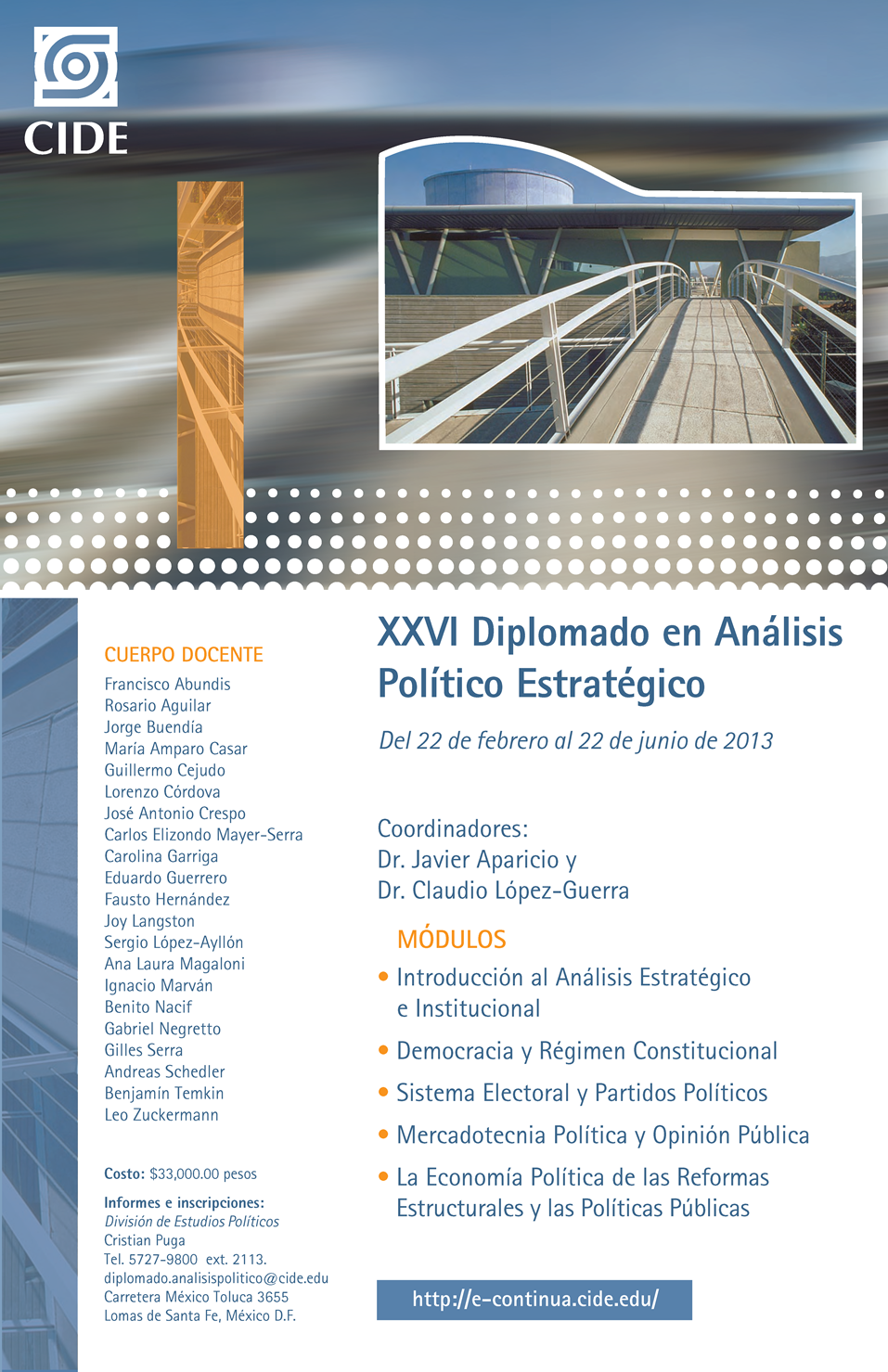
cartelDAPE26

El diplomado tiene dos objetivos centrales.  Por un lado, familiarizar al alumno con algunos de los principales enfoques teóricos y metodológicos de la Ciencia Política contemporánea. Por otro lado, que los participantes puedan utilizar estas herramientas analíticas para comprender el proceso político en México, así como la evolución de sus actores e instituciones clave.

A lo largo del diplomado analizaremos diferentes aspectos del proceso político-electoral: desde la toma de decisiones de votantes y representantes políticos, la competencia electoral y la negociación entre poderes, hasta la negociación e implementación de reformas y políticas públicas concretas.

El cuerpo docente incluye a reconocidos académicos del CIDE así como expertos de otras instituciones. Para mayor información sobre inscripciones y temario detallado, pueden consultar este website, o enviar un correo electrónico a Cristian Puga (puga.cristian2@gmail.com), coordinador aministrativo del Diplomado.

¡El cupo es limitado pero aún quedan lugares!
Strong opinions, weakly held

Paul Saffo’s mantra: “Strong opinions, weakly held

The point of forecasting is not to attempt illusory certainty, but to identify the full range of possible outcomes. Try as one might, when one looks into the future, there is no such thing as “complete” information, much less a “complete” forecast. As a consequence, I have found that the fastest way to an effective forecast is often through a sequence of lousy forecasts. Instead of withholding judgment until an exhaustive search for data is complete, I will force myself to make a tentative forecast based on the information available, and then systematically tear it apart, using the insights gained to guide my search for further indicators and information. Iterate the process a few times, and it is surprising how quickly one can get to a useful forecast.

Since the mid-1980s, my mantra for this process is “strong opinions, weakly held.” Allow your intuition to guide you to a conclusion, no matter how imperfect — this is the “strong opinion” part. Then –and this is the “weakly held” part– prove yourself wrong. Engage in creative doubt. Look for information that doesn’t fit, or indicators that pointing in an entirely different direction. Eventually your intuition will kick in and a new hypothesis will emerge out of the rubble, ready to be ruthlessly torn apart once again. You will be surprised by how quickly the sequence of faulty forecasts will deliver you to a useful result.

This process is equally useful for evaluating an already-final forecast in the face of new information. It sensitizes one to the weak signals of changes coming over the horizon and keeps the hapless forecaster from becoming so attached to their model that reality intrudes too late to make a difference.

More generally, “strong opinions weakly held” is often a useful default perspective to adopt in the face of any issue fraught with high levels of uncertainty, whether one is venturing a forecast or not. Try it at a cocktail party the next time a controversial topic comes up; it is an elegant way to discover new insights — and duck that tedious bore who loudly knows nothing but won’t change their mind!

Prorrateo de gastos de campaña

Este es mi blog invitado en Animal Político.

Para entender el prorrateo de los gastos de campaña (6 de febrero 2013)

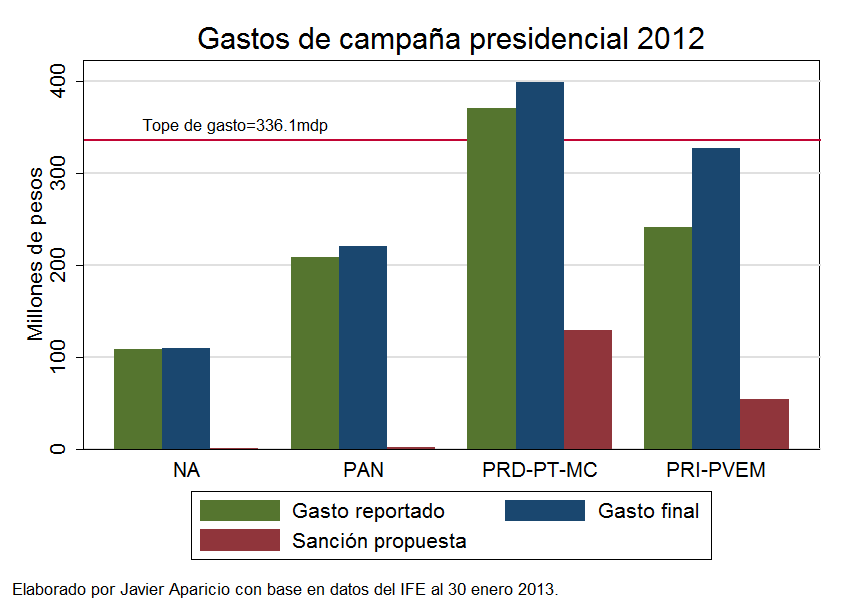
Está por resolverse la fiscalización de gastos de campaña de la pasada elección presidencial. El centro del asunto es si alguno de los candidatos excedió los topes de gasto de campaña marcados por la ley. Aunque la elección ya ha sido calificada por el Tribunal Electoral y el exceso de gasto no es una causal de nulidad, no se trata de un tema trivial. De hecho, el asunto retrata muy bien las deficiencias de la regulación electoral en México y la calidad de nuestra democracia. Este blog invitado busca explicar algunos aspectos clave de la fiscalización de campañas en México.
(ver nota completa)

Gastos de campaña presidencial 2012 reportados por los partidos vs. gasto detectado por la Unidad de Fiscalización del IFE:grafica_gastospresidente

Fórmula para prorrateo de gastos de campaña (Art. 177, Reglamento de fiscalización del IFE):Fórmula-Aparicio

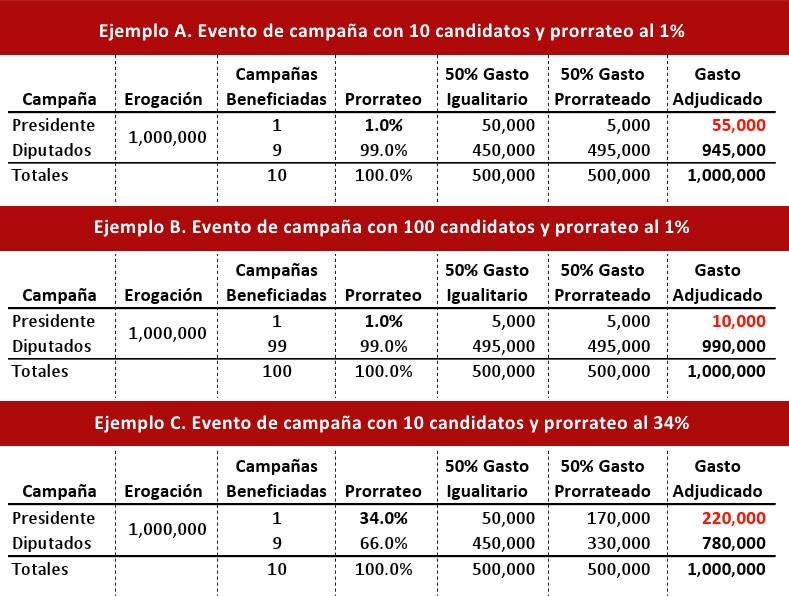
3 ejemplos hipotéticos de prorrateo de un evento de campaña de un millón de pesos:ejemplos_gasto

Otras entradas sobre gastos de campaña en este blog:

Aquí una visión más amplia del proceso electoral:

Otros blogs en Animal Político: aquí (18 julio 2012) y aquí (3 agosto 2012).