About Javier Aparicio

Profesor de la División de Estudios Políticos del CIDE, en México. (Assistant professor in the Political Studies Division at CIDE).

Are economists evil?

This is Paul Krugman in the New York Times Magazine (september 6, 2009):

How Did Economists Get It So Wrong?

I. MISTAKING BEAUTY FOR TRUTH

It’s hard to believe now, but not long ago economists were congratulating themselves over the success of their field. Those successes — or so they believed — were both theoretical and practical, leading to a golden era for the profession. On the theoretical side, they thought that they had resolved their internal disputes. Thus, in a 2008 paper titled “The State of Macro” (that is, macroeconomics, the study of big-picture issues like recessions), Olivier Blanchard of M.I.T., now the chief economist at the International Monetary Fund, declared that “the state of macro is good.” The battles of yesteryear, he said, were over, and there had been a “broad convergence of vision.” And in the real world, economists believed they had things under control: the “central problem of depression-prevention has been solved,” declared Robert Lucas of the University of Chicago in his 2003 presidential address to the American Economic Association. In 2004, Ben Bernanke, a former Princeton professor who is now the chairman of the Federal Reserve Board, celebrated the Great Moderation in economic performance over the previous two decades, which he attributed in part to improved economic policy making.

Last year, everything came apart.

Few economists saw our current crisis coming, but this predictive failure was the least of the field’s problems. More important was the profession’s blindness to the very possibility of catastrophic failures in a market economy. During the golden years, financial economists came to believe that markets were inherently stable — indeed, that stocks and other assets were always priced just right. There was nothing in the prevailing models suggesting the possibility of the kind of collapse that happened last year. Meanwhile, macroeconomists were divided in their views. But the main division was between those who insisted that free-market economies never go astray and those who believed that economies may stray now and then but that any major deviations from the path of prosperity could and would be corrected by the all-powerful Fed. Neither side was prepared to cope with an economy that went off the rails despite the Fed’s best efforts.

And in the wake of the crisis, the fault lines in the economics profession have yawned wider than ever. Lucas says the Obama administration’s stimulus plans are “schlock economics,” and his Chicago colleague John Cochrane says they’re based on discredited “fairy tales.” In response, Brad DeLong of the University of California, Berkeley, writes of the “intellectual collapse” of the Chicago School, and I myself have written that comments from Chicago economists are the product of a Dark Age of macroeconomics in which hard-won knowledge has been forgotten.

What happened to the economics profession? And where does it go from here?

You can read the whole thing here.   These are other viewpoints on the same question:

A quick and perhaps defensive reaction: and are there any non-economists who got it right?  Did any politician/historian/philospher got it right? Who should we turn now for financial and economic advice? In my view, if this debate boils down to reloaded Keynesians vs. neo-neoclassicals, it seems like the economics profession remains mostly unchallenged (for better or worse).

Toronto / APSA 2009

This weekend I will be attending the American Political Science Association Annual Conference, in Toronto, 3-6 September 2009. These are the abstracts of the papers that we will deliver.

The Political Economy of Collective Remittances: The Mexican 3×1 Program for Migrants

Javier Aparicio and Covadonga Meseguer

 Abstract.  The 3×1 Program for Migrants (Programa 3×1 para migrantes) is a matching grant scheme that seeks to direct the money sent by migrant organizations abroad to the provision of public and social infrastructure, and to productive projects in migrants’ communities of origin. To do so, the municipal, state, and federal governments match the amount sent by hometown associations at a 3 to 1 rate. We explore the types of projects awarded to assess whether the program is subject to political manipulation. Following the literature on redistributive politics, we posit that an increase in competition in municipal races may lead to more private (or clientelistic) projects awarded, relative to public infrastructure ones. Using data on the 3×1 Program for Migrants for over 2,400 municipalities in the 2002 to 2007 period, we find that municipalities with a higher effective number of political parties are associated with a lower provision of public goods funded by the 3×1 program. These results cast doubts about the program efficacy in promoting public welfare in politically competitive locations with high migration levels.


Committee Leadership Selection without Seniority: The Mexican Case

Javier Aparicio and Joy Langston

Abstract. How are committee leaders in legislatures chosen absent seniority norms?  This paper argues that the prior political experience of legislators can serve as cues to caucus leaders to reduce adverse selection in a legislature where seniority cannot be the basis of allocating committee leadership posts because of single term limits. We assess whether differences in background and expertise have any effect on the likelihood of leading major, issue, or duty panels in the Mexican Chamber of Deputies elected between 1997 and 2006. Using a dataset of 1,391 federal deputies, we estimate the effect of the level (federal, state or local) and type (legislative, bureaucratic or party) of their prior expertise on committee leadership. Using Bayesian multinomial logit models, we find that well educated legislators with bureaucratic expertise are more likely to lead a major committee than those with prior legislative or other national level expertise. We find mixed evidence for so-called state governor loyalists.

Who pays for health care?

Very basic ideas that journalists, pundits and politicians often misunderstand…  There is no free lunch because: 1. Everybody is a consumer.  2. Sooner or later, consumers pay for “everything”.

Who Really Pays for Health Care?: The Myth of “Shared Responsibility”
Ezekiel J. Emanuel, MD, PhD (Department of Bioethics, Clinical Center, National Institutes of Health); Victor R. Fuchs, PhD (Department of Economics, Stanford University). 
Journal of the American Medical Association. 2008; vol. 299: 1057-1059.

When asked who pays for health care in the United States, the usual answer is “employers, government, and individuals.” Most Americans believe that employers pay the bulk of workers’ premiums and that governments pay for Medicare, Medicaid, the State Children’sHealth Insurance Program (SCHIP), and other programs.

However, this is incorrect. Employers do not bear the cost of employment-based insurance; workers and households pay for health insurance through lower wages and higher prices. Moreover, government has no source of funds other than taxes or borrowing to pay for health care.

Failure to understand that individuals and households actually foot the entire health care bill perpetuates the idea that people can get great health benefits paid for by someone else. It leads to perverse and counterproductive ideas regarding health care reform.

This argument is also true in Mexico where the quality of IMSS/ISSSTE is so low that some employers resort to secondary or additional health care insurance from private providers.  If an employee ends up paying both the  public and private insurance premiums, the distortion on labor markets is even larger.  This is because public insurance (IMSS or ISSSTE fees) is mandatory in formal jobs: an employee cannot opt out of it if she chooses a secondary private option.

Special interests unite!

OpenSecrets.Org, also known as the Center for Responsive Politics, keeps track of the largest contributors to both the Republican or Democratic party.  These are the top 20 donors between 1989 and 2008.  Do note that this period includes Bush I and II, B illClinton as well as Obama’s election cycles.  The website includes lots of details by election year as well as by company. 

What I find remarkable is that the list is dominated by unions in this period.  Consider this the next time you hear claims that US democracy is captured by evil “corporate interests”.  Corporations, such as AT&T and Citibank, actually give as much to one party as the other, ie, they hedge their bets.  Unions, on the other hand, are lopsided toward the Democratic party. 

More details here.


1

ORGANIZATION

AT&T Inc

Total

$43,501,240

%Dem

44%

%Rep

55%

 
2 American Fedn of State, County & Municipal Employees $40,965,173 98% 1%   
3 National Assn of Realtors $35,179,013 48% 51%  
4 Goldman Sachs $31,183,662 64% 35%  
5 Intl Brotherhood of Electrical Workers $30,920,696 97% 2%   
6 American Assn for Justice $30,734,429 90% 9%   
7 National Education Assn $29,908,625 92% 6%   
8 Laborers Union $28,201,600 92% 7%   
9 Service Employees International Union $27,510,257 95% 3%   
10 Teamsters Union $27,402,304 92% 6%   
11 Carpenters & Joiners Union $27,368,258 89% 10%  
12 Communications Workers of America $26,748,746 99% 0%   
13 Citigroup Inc $26,562,905 50% 49%  
14 American Medical Assn $26,213,449 39% 60%  
15 American Federation of Teachers $25,996,071 98% 0%   
16 United Auto Workers $25,767,002 98% 0%   
17 Machinists & Aerospace Workers Union $24,793,477 98% 0%   
18 National Auto Dealers Assn $24,048,808 31% 68%  
19 Altria Group $23,869,891 28% 71%  
20 United Food & Commercial Workers Union $23,742,074 98% 1%   

Solicitud de Visa para Canadá

Como mucho sabrán, desde julio de este año el gobierno canadiense requiere que los mexicanos solicitemos visa (como turistas, estudiantes, etc.)  El website de la embajada canadiense provee la información necesaria en cuanto a los documentos que hay que presentar.  La solicitud es de suyo bastante engorrosa: Una parte se puede llenar en computadora pero el resto tiene que llenarse a mano (prepárense para declarar donde han vivido, trabajado o estudiado toda su vida, por ejemplo).

Pero hay dos trabucos más –el cheque de caja y la guía de envío prepagada– que no dependen tanto de la embajada y que pueden ser complicados para quienes vienen hasta la Ciudad de México solamente para hacer este trámite o quienes, como yo, no saben moverse muy bien en esta ciudad.  Si ya cuentan con todos los formatos y documentación necesaria para la aplicación, he aquí algunos tips para el día en que entreguen su solicitud:

  1. La embajada canadiense está en Schiller #529 y Tres Picos, entre Campos Eliseos y Reforma (justo detrás del Museo Nacional de Antropología), en Polanco.
  2. Hay un Banamex en Presidente Masaryk y Newton. El cheque de caja cuesta entre 180 y 240 pesos en ese banco, dependiendo de si eres cuentahabiente o no. En Masaryk están muchos otros bancos pero algunos, como Banorte, NO venden cheques de caja.  Otros, sólo los venden a “sus cuentahabientes”.
  3. La guía de envío prepagada se consigue fácilmente en DHL.  Hay un DHL en la calle de Taine, entre Homero y Horacio (es pequeño, pero bien que está allí).  Sobre Masaryk también están Estafeta y Multipack pero sorprendentemente ellos NO venden guías prepagadas (quizá no han descubierto que la embajada canadiense está allí a la vuelta mandando clientes a DHL).
  4. De plano, si necesitan fotocopias o fotos tamaño pasaporte de último minuto, busquen sobre Horacio, cerca del Metro Polanco.

Todo esto está a distancia caminable una vez que se encuentran en Polanco. He aquí un mapita con las coordenadas principales (está es la liga de google maps si desean un mayor detalle):

Embajada Canadiense en México

Hoy intenté solicitar mi visa, pero descubrir todo lo anterior me llevó más de 2 horas y no llegué a tiempo a la embajada.  Luego de hacer rabietas sobre los costos de toda esta odiosa transacción se me ocurrió hacer este “pequeño servicio a la comunidad”. De nada. 

UPDATE: Tan sólo una semana después de entregar mis papeles, la visa llegó a mi casa :-).

You could file this entry under “transaction cost economics”: in a more efficient economy, there would be a DHL or Banamex stand right there on the embassy charging premium prices for the added convenience.  In a more efficient political system, the Canadian Embassy would have figured out a simpler way for visa applicants–how about ONE single pdf form, or longer service hours?–so that Mexican tourism would not fall as much as it will now.

Big pharma

This is from Robert Reich blog:

I’m a strong supporter of universal health insurance, and a fan of the Obama administration. But I’m appalled by the deal the White House has made with the pharmaceutical industry’s lobbying arm to buy their support (…) Sunday’s New York Times reports that Big Pharma has budgeted $150 million for TV ads promoting universal health insurance, starting this August (that’s more money than John McCain spent on TV advertising in last year’s presidential campaign), after having already spent a bundle through advocacy groups like Healthy Economies Now and Families USA.

No, this not a Republican/Fox News kind of source.  Reich was secretary of labor under President Bill Clinton. He also served on President-Elect Obama’s transition advisory board…  IMHO, this proves that not all Democrats are on board with Obama–and that special interest politics is alive and well in the USA.

Statistics are sexy!

This is from The New York Times (August 6, 2009):

For Today’s Graduate, Just One Word: Statistics

MOUNTAIN VIEW, Calif. — At Harvard, Carrie Grimes majored in anthropology and archaeology and ventured to places like Honduras, where she studied Mayan settlement patterns by mapping where artifacts were found. But she was drawn to what she calls “all the computer and math stuff” that was part of the job.

“People think of field archaeology as Indiana Jones, but much of what you really do is data analysis,” she said. Now Ms. Grimes does a different kind of digging. She works at Google, where she uses statistical analysis of mounds of data to come up with ways to improve its search engine. Ms. Grimes is an Internet-age statistician, one of many who are changing the image of the profession as a place for dronish number nerds. They are finding themselves increasingly in demand — and even cool.

I keep saying that the sexy job in the next 10 years will be statisticians,” said Hal Varian, chief economist at Google. “And I’m not kidding.”

The rising stature of statisticians, who can earn $125,000 at top companies in their first year after getting a doctorate, is a byproduct of the recent explosion of digital data. In field after field, computing and the Web are creating new realms of data to explore — sensor signals, surveillance tapes, social network chatter, public records and more. And the digital data surge only promises to accelerate, rising fivefold by 2012, according to a projection by IDC, a research firm.”

Also related, a blog confession by Peter R. Orszag, director of the Office of Management and Budget:

The President has made it very clear that policy decisions should be driven by evidence – accentuating the role of Federal statistics as a resource for policymakers.  Robust, unbiased data are the first step toward addressing our long-term economic needs and key policy priorities.

In my speech this morning, I noted two particular areas where more and better data would be useful: health care and education.  In health care, bending the curve on cost growth will require more information about how we’re spending our health dollars, the health outcomes we’re producing, and how specific interventions rank against alternative treatments.  In education, better longitudinal data on the progress of individual students, which can be linked to specific programs and teachers, will go a long way to helping us understand what works better – and what doesn’t — and as a result, where to target scarce resources to bolster student achievement.

Elección 2009: resultados MR por género

Estos son los resultados de las elecciones 2009 en México en distritos uninominales o de mayoría relativa, distinguiendo entre candidatos y candidatas ganadores de cada partido. 

Resultados 2009 en distritos de mayoría relativa por género

Resultados 2009 en distritos de mayoría relativa por género

Cada punto en esta gráfica ilustra el porcentaje de votos de PAN, PRI y PRD en un distrito de mayoría relativa (los porcentajes de voto están normalizados para que su suma sea igual a 100).  Para entender la escala, nótese que los bastiones del PAN están en la parte superior del triángulo, los del PRI en el lado inferior derecho, y los del PRD en el izquierdo. Así, un distrito en el “centro” del triángulo indica un distrito reñido entre los tres principales partidos.  El color de cada punto indica el partido que ganó en ese distrito.

Más datos aquí.  Los resultados por representación proporcional están aquí.

Nota: Estos resultados forman parte del proyecto de investigación (en proceso): “Evaluación de la perspectiva de género en plataformas de partidos políticos, candidaturas y cargos de elección 2009“, financiado por el Instituto Nacional de las Mujeres.

Beware overconfident advice

An excellent post from Orgtheory.net:

From The New Scientist, some research showing that people prefer cockiness to expertise:

The research, by Don Moore of Carnegie Mellon University in Pittsburgh, Pennsylvania, shows that we prefer advice from a confident source, even to the point that we are willing to forgive a poor track record. Moore argues that in competitive situations, this can drive those offering advice to increasingly exaggerate how sure they are.

But this is pretty dangerous! Orgtheory.net also reminds us of:

(…)a famous paper by Kruger and Sunning showed, people who are bad at what they do are generally also incapable of understanding that they suck — and this directly contributes to inflated self-perception. So, incompetence tends to make people cocky and people prefer cocky judgements over demonstrated expertise, which is pretty much the worst of both worlds.

And this is Krueger and Sunning famous paper:

Unskilled and Unaware of It: How Difficulties in Recognizing One’s Own Incompetence Lead to Inflated Self-Assessments.

Justin Kruger and David Dunning / Cornell University

People tend to hold overly favorable views of their abilities in many social and intellectual domains. The authors suggest that this overestimation occurs, in part, because people who are unskilled in these domains suffer a dual burden: Not only do these people reach erroneous conclusions and make unfortunate choices, but their incompetence robs them of the metacognitive ability to realize it. Across 4 studies, the authors found that participants scoring in the bottom quartile on tests of humor, grammar, and logic grossly overestimated their test performance and ability. Although their test scores put them in the 12th percentile, they estimated themselves to be in the 62nd. Several analyses linked this miscalibration to deficits in metacognitive skill, or the capacity to distinguish accuracy from error. Paradoxically, improving the skills of participants, and thus increasing their metacognitive competence, helped them recognize the limitations of their abilities.

Elección 2009: Género y Representación Proporcional

Estos son los resultados de la elección federal 2009 para el PAN, PRI y PRD, por el principio de representación proporcional. 

Diputados Federales por Representación Proporcional 2009
  Candidatos Ganadores
Partido Político Hombres Mujeres Total Hombres Mujeres Total
PAN 106 94 200 42 31 73
  53 47 100% 57.53 42.47 100%
PRD 95 105 200 15 17 32
  47.5 52.5 100 46.88 53.13 100%
PRI 100 100 200 31 22 53
  50 50 100 58.49 41.51 100%
PVEM 112 88 200 10 8 18
  56 44 100 55.56 44.44 100%
PANAL 100 100 200 5 3 8
  50 50 100 62.5 37.5 100%
PSD 100 100 200
  50 50 100
CONV 85 82 167 3 3 6
  50.9 49.1 100 50 50 100%
PT 107 93 200 6 4 10
  53.5 46.5 100 60 40 100%
Total 805 762 1,567 112 88 200
  51.37 48.63 100% 56 44 100%
Cálculos propios con base en datos del IFE.        

Y ésta es la gráfica por circunscripción para el PAN, PRI y PRD:


Nota: Estos resultados forman parte del proyecto de investigación (en proceso): “Evaluación de la perspectiva de género en plataformas de partidos políticos, candidaturas y cargos de elección 2009“, financiado por el Instituto Nacional de las Mujeres.

Género y la elección 2009

DISTRIBUCION DE GÉNERO DE CANDIDATURAS VS. RESULTADOS ELECTORALES
DIPUTADOS FEDERALES POR MAYORIA RELATIVA 2009

En la reciente elección federal para renovar el Congreso, el PAN nominó a 108 candidatas para los 300 distritos uninominales. El PRI sólo nóminó a 55.  En la elección, 30 mujeres priistas ganaron en sus respectivos distritos. Por el PAN, solamente 17 consiguieron el triunfo. Por su lado, el PRD nominó 87 candidatas y sólo 7 ganaron.

En total, 53  de las 300 curules MR serán para mujeres (18%).  La mayoría de las diputadas de la próxima legislatura provendrán de la listas plurinominales (more later on this).


Elección para Diputados Federales por Mayoría Relativa 2009
  Candidatos Ganadores
Partido o Alianza Hombres Mujeres Total Hombres Mujeres Total
PAN 192 108 300 54 16 70
  64.0 36.0 100% 77.14 22.86 100%
PRD 213 87 300 32 7 39
  71 29 100 82.05 17.95 100
PRI 188 49 237 112 26 138
  79.32 20.68 100 81.16 18.84 100
PVEM 141 96 237      
  59.49 40.51 100
PANAL 194 97 291      
  66.67 33.33 100      
PSD 194 106 300
  64.67 35.33 100      
Primero México (PRI + PVEM) 57 6 63 46 4 50
  90.48 9.52 100 92 8 100
Salvemos a México (PT+Conv.) 214 86 300 3 0 3
  71.33 28.67 100 100 0 100
Total 1,393 635 2,028 247 53 300
  68.69 31.31 100% 82.33 17.67 100%


Este resultado se pudo anticipar al clasificar la distribución de candidatas por “tipo de distrito”: bastión, reñido y perdedor.  El PAN y PRD nominaron a la mayoría de sus candidatas en distritos históricamente “perdedores”. El PRI no tuvo un sesgo tan marcado.  Por ello, aún nominando a pocas candidatas, el PRI cosechó más curules MR para mujeres que sus rivales.


Candidatos de mayoría relativa del PAN 2009 por Tipo de distrito
Tipo de distrito Candidatos %H Candidatas  %M Total %
Perdedor 103 56.9% 78 43.1% 181 100%
Reñido 34 77.3% 10 22.7% 44 100%
Bastión 55 73.3% 20 26.7% 75 100%
TOTAL 192 64.0% 108 36.0% 300 100%
             
             
Candidatos de mayoría relativa del PRD 2009 por Tipo de distrito
Tipo de distrito Candidatos %H Candidatas  %M Total %
Perdedor 156 68.7% 71 31.3% 227 100%
Reñido 22 75.9% 7 24.1% 29 100%
Bastión 35 79.5% 9 20.5% 44 100%
TOTAL 213 71.0% 87 29.0% 300 100%
             
             
Candidatos de mayoría relativa del PRI 2009 por Tipo de distrito
Tipo de distrito Candidatos %H Candidatas  %M Total %
Perdedor 102 79.1% 27 20.9% 129 100%
Reñido 43 81.1% 10 18.9% 53 100%
Bastión 100 84.7% 18 15.3% 118 100%
TOTAL 245 81.7% 55 18.3% 300 100%
* Distritos reñidos: aquellos con margen de victoria promedio de ±5% entre 1997 y 2006.  


Nota: Estos resultados forman parte del proyecto de investigación (en proceso): “Evaluación de la perspectiva de género en plataformas de partidos políticos, candidaturas y cargos de elección 2009“, financiado por el Instituto Nacional de las Mujeres.

Elección 2006 – una historia conocida

Hoy la elección presidencial 2006 parece ser ya parte de la historia.  Lejos quedan los debates sobre el PREP, errores en actas, recuento de paquetes, representantes de casilla, etc.  En la elección 2009 ninguno de estos asuntos fue “tema” de discusión o interés.  Buena señal.  Y es que entre los problemas vigentes de nuestro sistema electoral, los asuntos de difusión de resultados y llenado y escrutinio de actas, que los hay, no son prioridad.

Quizá valga la pena analizar los ajustes del recuento de paquetes electorales 2009: gracias a la nueva legislación y el volumen de votos nulos se recontaron mucho más paquetes en 2009, cuando a casi nadie le importaba, que en 2006.   De modo que en 2009 podremos aprender mucho más sobre qué tanto se equivocan los funcionarios de casilla al contar votos y llenar actas.  Si sobre tiempo exploraré este asunto en breve.

Entretanto, finalmente mi artículo “Análisis estadístico de la elección presidencial de 2006: ¿fraude o errores aleatorios? está por aparecer en la revista Política y Gobierno, volumen temático 2009-Elecciones en México, págs. 225-243.  Give it a look and travel back in time: 

Resumen: Este artículo confronta algunas de las principales acusaciones de fraude electoral con la evidencia disponible mediante un análisis estadístico de los datos a nivel casilla del PREP y del cómputo distrital de la elección presidencial de 2006. En primer lugar se analiza el conteo rápido, el flujo de datos del PREP y del cómputo distrital; en segundo lugar, los errores aritméticos en las actas de casilla y el recuento de paquetes electorales, y por último el papel de las casillas atípicas y los representantes de casilla. La conclusión principal es que, a pesar de los errores en actas y los sesgos propios del flujo de datos, el resultado electoral del 2 de julio resulta estadísticamente confiable.

 Statistical Analysis of the Presidential Election in 2006: Fraud or Random Errors?

 Abstract: This paper tests some of the main fraud allegations of the 2006 presidential election in Mexico with the evidence from a statistical analysis of precinct-level data. First, I analyze the data flow from the quick count, the preliminary results (PREP) and the official district tally (cómputo distrital). Secondly, I analyze the size and distribution of errors in the polling-station acts and the partial recount. Lastly, I consider atypical precincts and the role of party representatives. My main conclusion is that, since most fraud allegations are not supported by the evidence, the presidential election outcome is statistically reliable.

Pobreza por ingresos en México

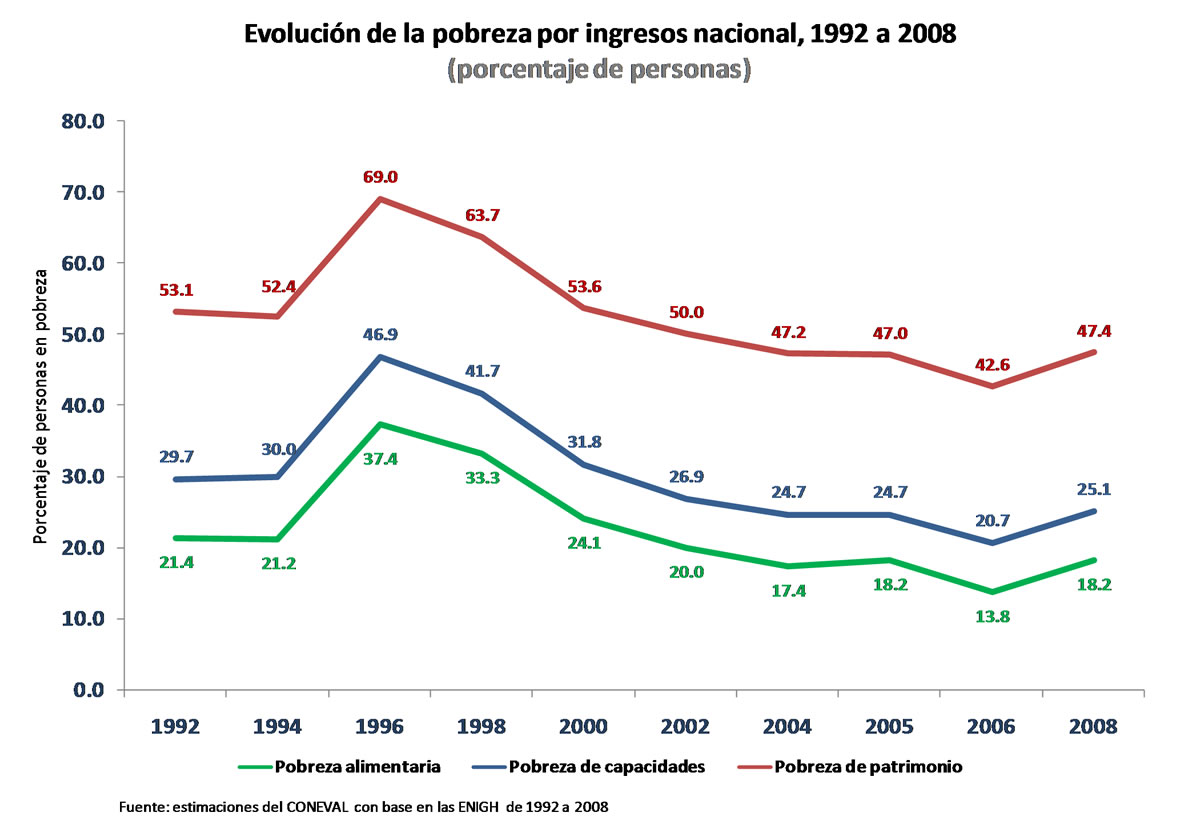
CONEVAL acaba de hacer público un detallado reporte con las cifras de pobreza por ingresos para 2008, estimadas con base en la ENIGH.  Los datos que mayor impacto han tenido en los medios son dos:

  • Entre 2006 y 2008, el porcentaje de personas en condición de pobreza alimentaria a nivel nacional aumentó de 13.8% a 18.2% (de 14.4 a 19.5 millones de personas).

  • Entre 2006 y 2008, el porcentaje de personas en condición de pobreza de patrimonio en el país se incrementó de 42.6% a 47.4% (de 44.7 a 50.6 millones de personas).

Sin embargo, el reporte de CONEVAL contiene datos (con gran nivel de detalle, por cierto) desde 1992 hasta 2008.  Al parecer, el lento avance observado entre 1996 y 2006, ha tenido un revés: los niveles de pobreza de 2008 son similares a los de 2005.  ¿Hasta donde retrocederemos en 2009?  ¿Retrocederemos tanto como entre 1994 y 1996? 

Evolución de la pobreza por ingresos en México

Impossible accountability?

Economists like to use phrases like: “sure, poverty and unemployment are on the rise (or whatever) but things would have been even worse if POLICY X had not been implemented.” Conversely, political scientists use phrases like: “sure, with the recession the incumbent party was set to lose seats but they would have lost many more seats if CAMPAIGN X had not been implemented.”

You guessed it: these counter-factuals are never observed–academics and experts just estimate these counterfactuals with a little help from theories and statistical methods.  But what if the estimated counterfactuals are really off the mark? In real-world policymaking, this makes accountability an almost impossible task…

Greg Mankiw tackles this very issue here.

Miedo a las encuestas

 De vez en cuando se escuchan argumentos en contra del levantamiento y difusión de encuestas debido a la “influencia desmedida” que pueden tener en el electorado, en la estrategia de los candidatos y otros actores.  Nuestro propio COFIPE prohibe la difusión de encuestas en los días previos a la elección.  En lo personal, me parece muy extraño el “temor a la información” que las encuestas (ya sean electorales, sobre políticas públicas, popularidad presidencial, etc.) despiertan en algunos periodistas y analistas de diverso calibre.

He aquí un debate sobre este tema entre Conor Clarke (The Atlantic) y John Sides (The Monkey Cage):

1. Conor Clarke’s proposal to “get rid of polls” in The Atlantic Monthly.

2. John Sides replies in The Monkey Cage: “Should We Get Rid of Polls?”

3. Counter-reply by Conor Clarke: Why Do We Care About Polls?

4. Counter-reply by John Sides:  “Why Should We Have Polls?”

…I say the Monkey Cage wins against the “no information” argument…