Financiamiento a partidos (webcast)

Este martes 10 de noviembre al mediodía se llevó a cabo en el CIDE la mesa de redonda: ¿Para qué sirve el financiamiento público a partidos en México?, con la participación de John Ackerman – UNAM, Javier Aparicio – CIDE, Ma. Amparo Casar – CIDE, y Jorge Javier Romero – UAM.

El evento fue transmitido en línea y pueden ver la grabación aquí. El shortlink del webcast es:  http://bit.ly/2WgyN1

El orden y horario de las intervenciones fue el siguiente:

Ma. Amparo Casar – CIDE    (min 0:00)
Jorge Javier Romero – UAM   (min 21:00)
John Ackerman – UNAM   (min 38:30)
Javier Aparicio – CIDE   (min 55:30)
Preguntas y respuestas   (1hr 15min)

Social science humor

Via Monkey Cage, a selection of humorous quotes on Social Science, “all collected or concocted by the irrepressible A. Wuffle. If you like this sort of thing, then stay tuned for the soon-to-be-released Wit and Humor of Political Science (Sigelman, Newton, Meier, and Grofman, eds., which is slated for publication in January)”:

Thou shalt not commit a Social Science. — W. H. Auden

God gave all the easy problems to the physicists. – James March

In the social sciences, waiting for Newton is like waiting for Godot. — Lee Cronbach and Philip Converse

To avoid the problem of scientific validity, three strategies are commonly followed in the social sciences: (a) eschewing falsifiable statements; (b) denying the possibility of objective truth, and (c) writing in French or German. The combination of these three strategies has been shown to be virtually irresistible, even to strong minds. Statements which on the face of it are unintelligible gibberish can always be blamed on a bad translation. — A Wuffle

An economist is one who observes something that works in practice and wonders if it will work in theory. — As told to Bernard Nelson by Victor Fuchs

If you put all the economists in the country end to end, they’d still point in different directions. — Harry S. Truman

The Economist’s Motto: To err is human, to be paid for it divine. — Victor Fuchs

Those who do not know the past are condemned to repeat History 101. — Anon.

I dropped out of American Studies after the first exam, when I found out that the correct answer to all four questions was “hegemony.” — Emily Polsby

If you can understand an article in the APSR then something must have gone wrong in the refereeing process. – A Wuffle

Sociology is the branch of science with the most methods and the least results. – Henri Poincare, circa 1909-10

Financiamiento a partidos: Regulación

En México existe un amplio debate sobre el papel del dinero en la política y cómo regularlo.  Entre las grandes preguntas de este debate tenemos: ¿Cuánto debe subsidiarse una democracia en general, y a los partidos o candidatos en particular? ¿Deben limitarse las fuentes de ingresos de los partidos y candidatos—cuánto y de quiénes? ¿Deben limitarse los gastos de campaña—desde cuándo, cuánto y cómo? Por último, ¿cómo se puede regular  y monitorear el origen y aplicación de estos recursos de manera eficiente?  No existe una respuesta claramente establecida para todas estas preguntas pero vale la pena echar un vistazo a lo que hacen en otras latitudes.

Esta tabla resume la regulación del financiamiento a partidos políticos en 14 democracias “consolidadas”.  Jacaranda Pérez y un servidor hemos analizado un conjunto más amplio de países (aquí, por ejemplo) pero esta muestra es bastante ilustrativa de las prácticas más comunes. 

Si bien 10 de 14 países ofrecen financiamiento público a partidos, solo 2 de ellos establecen topes al gasto de campaña. Junto con el financiamiento público, la regulación más común son los requisitos de rendición de cuentas de ingresos y gastos (disclosure requirements). Nótese además que alrededor de un tercio de estos 14 países imponen restricciones de algún tipo a las contribuciones de individuos o corporaciones.  Por último, resalta que pocos países financian más del 50% del gasto de los partidos (estos porcentajes deben interpretarse con cuidado pues es muy difícil medir de manera confiable el gasto total de los partidos).

Financing of Political Parties: General Regulations and Methods    
      Limits on Contributions:      
Country Public funding=1 PubFund as % of total Indivi-duals Corpo-rations Expenditure limits=1 Disclosure req’mt =1 Limitations index
Austria 1 71 0 0 0 0 0
France 1 50 1 1 0 0 2
Germany 1 30 0 0 0 1 1
Italy 1 n.a. 0 1 0 1 2
Netherlands 1 26.5 0 0 0 1 1
Portugal 1 90 1 1 0 1 3
Spain 1 90 0 0 0 1 1
Sweden 1 50 0 0 0 0 0
Switzerland 0 0 0 0 0 0 0
United Kingdom 0 0 0 0 1 1 2
Australia 1 61 0 0 0 1 1
Canada 0 0.1 0 0 1 1 2
Japan 1 34 1 1 0 1 3
United States 0 0 1 1 0 1 3
               
Totals / Averages 10 38.66 4 5 2 10 1.50

Fuente: Elaboración propia con base en Karl-Heinz Nassmacher, IDEA Handbook on Funding Parties and Election Campaigns, 2003.

Printed media: the end is near?

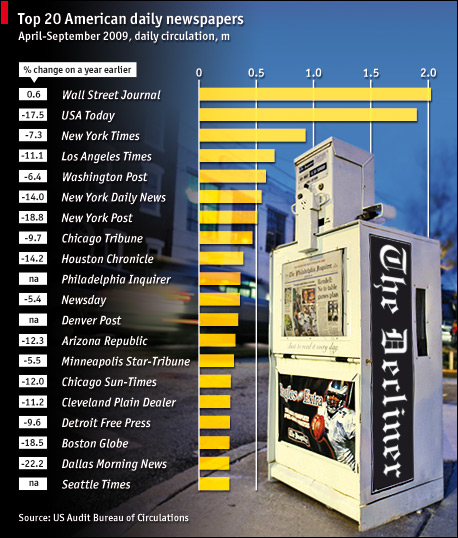
La circulación de periódicos más importantes en los Estados Unidos está en franco declive.  Una parte puede deberse a la recesión pero tampoco puede negarse una tendencia de largo plazo.  Todos los diarios, salvo el WSJ, sufrieron caidas en los últimos 12 meses.  Hay quienes se preocupan por la influencia desmedida de los medios.  Justificadas o no, la mucha o poca influencia de la prensa va en declive.  La lección subyacente es clara: el poder de mercado de un medio (impreso, televisivo, electrónico) no puede durar por siempre.  Imagino que la historia es bastante similar para las “grandes cadenas” noticiosas (ABC, CNN, Fox, etc.).

US_NewspapersReadership_oct09

La gráfica es de The Economist.  Más comentarios sobre el significado de estas tendencias en The Atlantic Wire.

Miscelanea fiscal y no fiscal

Hay varios temas de coyuntura que merecen su entradita en este blog… pero estoy muy ocupado con otras cosas.  He aquí el wish list:

1. Un poco más sobre la extinción de LFC y su sindicato.  Who wins and loses with unions in general, and in particular those like SME?

2. La Ley de Ingresos para 2010 -parte fundamental del paquete fiscal. Existen buenas y malas razones para criticar el proyecto de ley enviado al Senado esta semana.  We do need more tax revenues but not this sort of new revenues.

3. Un breve comentario sobre el backlash en contra del impuesto a telecomunicaciones (#internetnecesario). ¿El movimiento twittero ayuda o perjudica a Slim? ¿Por qué otros impuestos no generan el mismo tipo de reacción?

4. Por qué tiene sentido elevar o relajar los topes de gasto de campaña, disminuir o mantener constante el financiamiento público a partidos, y reforzar la fiscalización de ingresos y gastos de los partidos (ie, explicar mi statement en youtube).

XV Aniversario Política y Gobierno

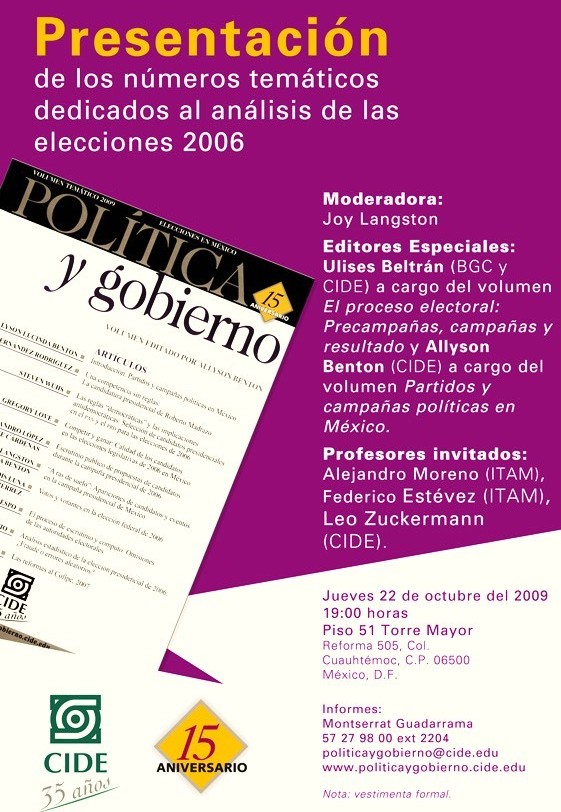
INVITE PG2La Revista Política y Gobierno del CIDE celebra su XV aniversario con la publicación de dos volúmenes temáticos sobre “ELECCIONES EN MÉXICO”.
Editores especiales:
Ulises Beltrán, BGC y Asociados / CIDE
Allyson Benton, CIDE

Moderadora:
Joy Langston, CIDE (editora de P&G)
Panelistas:
Federico Estévez, ITAM
Alejandro Moreno, ITAM
Leo Zuckermann, CIDE

Fecha y lugar:
Jueves 22 de octubre, 7pm
Piso 51 Torre Mayor
Ave. Paseo de la Reforma 505

*Nota: vestimenta formal (ni jeans ni tenis, pues :-)

Paul Romer’s big idea: charter cities

This picture appears on the homepage of Charter Cities, Paul Romer’s project to change the world, one city at a time.

The FAQ of the website elaborates a bit more:

Q: Why are these students studying under streetlights?
A: They don’t have electricity at home, so they go to the airport to study for exams. See the news report describing their situation.

Q: Why do you display this picture on your home page?
A: All too often, the picture associated with the challenge of development is one of a starving child. This kind of picture may be helpful in motivating giving, but it does not necessarily lead to careful thinking about the forces that hold so many people back. There are, to be sure, desperate cases of people who are truly helpless. But images of extreme deprivation often obscure the fact that many of the world’s poorest residents attempt to help themselves, only to be stymied by bad rules.

Q: What kinds of rules keep people from having light in their homes?
A: Here are some simple examples of rules that can keep people in the dark: 

  •  
    • Electricity is provided only by a government-owned firm.
    • Government employees can’t be fired, regardless of how poorly they do their jobs.
    • The low subsidized price of electricity for the lucky consumers who have access is determined by political considerations.

Under good governance, the people who want electricity in their homes can easily match up with the utilities that want to provide it to them.

There is more info at the chartercities.org website.
This is Paul Romer conference on: “A Theory of History, with an Application” (1 hr video)
And this a shorter TED talk (18min):

Institutional economics and the Nobel

Some economists are strangely upset that Elinor Ostrom, a political scientist, got the economics Nobel prize this year. Even Steve Levitt admitted that he was rather unfamiliar with her work. I am glad she got the award, and I am also glad that I knew her work–Williamson and Ostrom being familiar figures in the public choice literature I studied at GMU.

In case you missed it, there is a continuum theme in the Nobel awards given to Ronald Coase, Douglass North, James Buchanan, and now Oliver Williamson and Elinor Ostrom–the overarching importance of rules and institutions. The Economics Nobel committee makes this case here. Of course, other things matter as well, but if you don’t change the rules it will be difficult to expect any substantive change in behavior. Admittedly, Mancur Olson, Gordon Tullock, and Oliver Hart, who have not received the Nobel, also belong in this tradition.  Paul Romer puts it better than many others:

Skyhooks versus Cranes: The Nobel Prize for Elinor Ostrom

Most economists think that they are building cranes that suspend important theoretical structures from a base that is firmly grounded in first principles. In fact, they almost always invoke a skyhook, some unexplained result without which the entire structure collapses. Elinor Ostrom won the Nobel Prize in Economics because she works from the ground up, building a crane that can support the full range of economic behavior.

When I started studying economics in graduate school, the standard operating procedure was to introduce both technology and rules as skyhooks. If we assumed a particular set of rules and technologies, as though they descended from the sky, then we economists could describe what people would do. Sometimes we compared different sets of rules that a “social planner” might impose but we never said anything about how actual rules were adopted. Crucially, we never even bothered to check that people would actually follow the rules we imposed.

A typical conclusion was that rules that assign property rights and rules that let people trade lead to good outcomes. What’s the skyhook? That people will follow the rules. Why would they respect the property rights of someone else? We had no idea. We might have had in mind something like this: police officers will arrest people who don’t follow the rules. But this is just another skyhook. Who are these police officers? Why do they follow rules? This is not an idle concern. Elinor showed that there are lots of important cases where people follow rules about ownership without police officers. One of the central challenges in understanding failures of economic development is that in many places, police officers don’t follow the rules they are meant to enforce.

Elinor’s fieldwork, followed up by her experimental work, pointed us in exactly the right direction. To understand BOTH why we don’t need police officers in some cases AND why police officers don’t follow the rules in other cases, we have to expand models of human preferences to include a contingent taste for punishing others. In reaching this conclusion, she arrived at a point similar to that reached by Avner Greif (whom the Nobel committee correctly cites.) They, more than anyone else in the profession, spelled out the program that economists should follow. To make the rules that people follow emerge as an equilibrium outcome instead of a skyhook, economists must extend our models of preferences and gather field and experimental evidence on the nature of these preferences.

Economists who have become addicted to skyhooks, who think that they are doing deep theory but are really just assuming their conclusions, find it hard to even understand what it would mean to make the rules that humans follow the object of scientific inquiry. If we fail to explore rules in greater depth, economists will have little to say about the most pressing issues facing humans today – how to improve the quality of bad rules that cause needless waste, harm, and suffering.

Cheers to the Nobel committee for recognizing work on one of the deepest issues in economics. Bravo to the political scientist who showed that she was a better economist than the economic imperialists who can’t tell the difference between assuming and understanding.

Luz y fuerza del centro

Las democracias tienden a favorecer arreglos económicamente ineficientes en aras de sostener coaliciones políticas de distinta índole. Los ejemplos abundan: tarifas, aranceles, controles de precios y regulaciones de todo tipo son económicamente ineficientes pero útiles para proteger a ciertos grupos de interés y/o votantes pivotales. Democracias jóvenes como la nuestra son aún más proclives a proteger un statu quo a todas luces ineficiente: nuestras paraestatales y sindicatos públicos son poderosos por sí mismos, pero al mismo tiempo cuentan con el apoyo de votantes proclives a “creer” en ellos (el petróleo es “nuestro”, la privatización es “mala”). No se trata de sugerir soluciones autoritarias, sino de comprender mejor el tipo de políticas públicas que resultan de toda democracia: unas lo hacen mejor que otras y hay que entender por qué.

La medianoche del domingo 11 de octubre se decretó la extinción de Luz y Fuerza del Centro. Aunque no requería aprobación del Congreso, este decreto llevaba años en la congeladora y se había postergado por razones políticas más que económicas–de hecho, postergarlo resultaba cada año más costoso.  En la medida en que enfrenta un fuerte grupo de interés como el SME, ésta es una decisión “valiente” de Felipe Calderón: ojalá no se eche para atrás ni se hagan demasiadas concesiones al SME para poder extinguir la empresa–de hacerlo, perdería los muy escasos márgenes de maniobra que tiene para lidiar con otros poderes fácticos.

Los líderes partidistas y otros sindicatos se posicionarán en torno a esta medida.  No deja de sorprender que unos u otros defiendan causas tan indefendibles como la de los sindicatos públicos en México. ¿Por qué? Las evidencia indica que tanto nuestras paraestatales (PEMEX, CFE, LFC, etc) son escandalosamente ineficientes, y sus respectivos sindicatos son escandalosamente onerosos.  Claramente, que los contribuyentes subsidien tales niveles de ineficiencia, en vez de atender otras necesidades más urgentes (fill in the blank here with your favorite social program) es socialmente indeseable y, dadas nuestras carencias, una injusticia social.

A menudo se dice que “eficiencia” y “justicia” no van en el mismo sentido pero, en términos de finanzas públicas, sostener un aparato tan ineficiente con el erario público es de suyo injusto.  Me explico: hoy se nos dice que los subsidios a LFC (41.9 mmdp en 2009) son casi equivalentes al costo del Programa Oportunidades. Es decir que año con año el gobierno había “decidido” (junto con nuestro muy plural Congreso) subsidiar a LFC en vez de incrementar sustancialmente el combate a la pobreza (u otras inversiones sociales de alto impacto).  Eso es “injusto” casi bajo cualquier enfoque filosófico (o función de utilidad social, por así decirlo).

El gobierno federal estima destinar 20 mil millones de pesos para la liquidación de LyFC.  ¿Tiene sentido hacerlo desde un punto de vista costo-beneficio? Es una cifra desorbitante, hasta que lo comparamos con el costo actual de mantener en operación a LFC.

Macario Schettino ofrece gráficas sobre los flujos de transferencias a LFyC en los últimos años. Y José Luis de la Cruz Gallegos ofrece una numeralia interesante en El Universal de hoy:

  • Subsidios y transferencias en 2009 por concepto de adquisición de energía eléctrica: 41 mil 900 millones de pesos
  • Presupuesto de Egresos aprobado en 2009 para LyFC: 33.7 mil millones de pesos,
  • de los cuales 11.8 mil millones (35%) están dedicados a su sistema de pensiones y jubilaciones
  • y 12.8 mil millones de pesos van dirigidos a los servicios personales de LyFC.
  • Gasto en inversión física: sólo 6.8 mil millones de pesos (20.2%)
  • Nómina:  más de 44 mil empleados y 22 mil jubilados.
  • Indemnización promedio que se ofrecerá a los trabajadores: 33 meses de sueldo.

Dos preguntas pertinentes son: ¿si la LFC llevaba años en números rojos, por qué hasta ahora se toma la decisión? ¿Por qué se decidió confrontar al SME y no a otros sindicatos igual o más perniciosos, como el sindicato de petroleros y el mismo SNTE?  Simple, por el costo político que implica el hacerlo. El poder de negociación de los grandes sindicatos está no sólo en su capacidad de movilizar grandes masas (“paralizar el país”) sino también por el apoyo directo o indirecto que éstos ofrecen a los partidos políticos. Por diversas razones, reformar el sector público en México –desde la burocracia hasta las grandes paraestatales– ha sido mucho más difícil que reformar otras áreas (como la política macroeconómica, pensiones privadas, el TLC y el mismo COFIPE).

No es gratuito que ni siquiera Salinas o Zedillo –ambos presidentes más “fuertes” que Fox o Calderón– confrontaron en su momento a  estos grupos.  Si Salinas hubiese impulsado una reforma energética profunda junto con el TLC, el STPRM/PEMEX se hubiera acercado aún más al PRD.  Del mismo modo, si Calderón diera la espalda a el SNTE, Elba y su aparato magisterial volverían al PRI (o incluso al PRD).  Por eso dije al inicio que bajo nuestra democracia es muy difícil trastocar este tipo de arreglos, a menos que las condiciones sean lo suficientemente críticas, como al parecer ocurrió ahora con Luz y Fuerza del Centro.

To be continued…

The social value of postmodernism

This is Bryan Caplan (one of the great professors I had at GMU) citing Chomsky, and reflecting on the social value of postmodernism… simply hilarious!

“I stumbled across an atypically insightful essay by Noam Chomsky, “What Is Wrong With Science and Rationality?,” in the colorfully-named collection Market Killing. You can read a nearly complete version of the essay here. Chomsky pushes two theses in this essay.

First, postmodernism makes no sense:

[T]o take part in a discussion, one must understand the ground rules. In this case, I don’t. In particular, I don’t know the answers to such elementary questions as these: Are conclusions to be consistent with premises (maybe even follow from them)? Do facts matter? Or can we string together thoughts as we like, calling it an “argument,” and make facts up as we please, taking one story to be as good as another? … What seems to be under discussion here is whether we should abide by these ground rules at all (trying to improve them as we proceed). If the answer is that we are to abide by them, then the discussion is over: we’ve implicitly accepted the legitimacy of rational inquiry. If they are to be abandoned, then we cannot proceed until we learn what replaces the commitment to consistency, responsibility to fact, and other outdated notions. Short of some instruction on this matter, we are reduced to primal screams.

Second, postmodernist philosophy makes it hard to persuasively communicate your substantitive views to a broad audience:

And it is hard for me to see how friends and colleagues in the “non white world” will learn more from the advice given by “a handful of scientists” who inform then that they should not “move on the tracks of western science and technology,” but should prefer other “stories” and “myths”–which ones, we are not told, though astrology is mentioned.

I think Chomsky’s basically right on both counts. Which puts me in a quandary. As long as postmodernism remains a delusion of the left, I’m afraid I’ve got to admit it has a socially useful function: It serves as a barricade between leftist intellectuals and their target audience. There is no surer way to turn off a crowd of anti-globlization protestors than to make them listen to some windbag go on and on about “What Derrida said Foucault should have said Sartre meant to say.

The economic point of view

By accident, I ran into a commencement address by Chicago Economist Kevin M. Murphy: “Seeing the World through the Economic Lens” (June 11, 2006).  It’s not about poetic remarks but about equilibrium, incentives and cost-benefit analysis. These are the final paragraphs of the address:

“So don’t forget the concepts of equilibrium, such as there’s no free lunch. And if it looks too good to be true, it probably is. But that doesn’t mean you shouldn’t push forward. Just be cautious and be humble, because most likely you are going to turn out to be wrong.

On the incentives side, remember that incentives matter. You give people incentives to do good things, and they will do good things. You give people incentives to do bad things, and they will do bad things. And remember incentives apply in all contexts. So, for example, a common response to a public policy problem is to say that the solution is to get the government to do it. But does the government have the incentive to do it right? What incentive do they have? Their incentives often are not to do it right. Their incentive is to do it with a lot of people at a lot of expense, because that’s how they define success in their business. So it’s not that the people in government are bad or evil but rather that they are subject to the same incentives as you and me. You just have to recognize what those incentives are. And when faced with a problem, use the principles of cost-benefit analysis. Think about the true goals, identify the goals, and, most importantly, identify the options and make comparisons between benefits and costs of one option versus another.”

In the same year, Austan Goolsbee gave a very entertaining address: “Why People Hate Economists (and Why We Don’t Care)“:

(Economics is) about a way of thinking about the world. It starts from the basic theory that, for the most part, people try to do better for themselves. If this is true, they will respond to incentives so that, in most cases, competition will drive them to be more efficient. That theory then says: Let’s get the data and think hard about causality, because we don’t have much in the way of controlled experiments. And let’s see how far that will take us.

But that simplicity of purpose is quite a large part of why people hate us. We really don’t deal with the loftiest ideals of humanity. We deal with humans at their most mundane. We aren’t about narratives and inspiration or how people would behave in their finest hours. We are about how people behave in the everyday marketplace. I think we are especially hated because of the nagging fear on the part of idealists that we might be right about people.

(…) But that’s the problem with economics. It’s always taking the fun out of everything. As I like to say, economics is frequently hated but seldom wrong.

Also related, a previous post on Nirvana fallacies, according to Harold Demsetz; and another one on Economic Imperialism, according to Ed Lazear.  So, yes, this maybe a favorite or recurring topic of mine :-).  This is from Ed Lazear:

It is the ability to abstract that allows us to answer questions about a complicated world. As economists, however, we believe in comparative advantage. I have argued elsewhere that the strength of economic theory is that it is rigorous and analytic. But the weakness of economics is that to be rigorous simplifying assumptions must be made that constrain the analysis and narrow the focus of the researcher. It is for this reason that the broader thinking sociologists, anthropologists and perhaps psychologists may be better at identifying issues, but worse at providing answers. Our narrowness allows us to provide concrete solutions, but sometimes prevents us from thinking about the larger features of the problem. This specialization is not a flaw; much can be learned from other social scientists who observe phenomena that we often overlook. But the parsimony of our method and ability to provide specific, well-reasoned answers gives us a major advantage in analysis.

Top ten a los 90 días

Llevo más de 4 años bloggeando–primero en blogspot, sin estadísticas–y desde hace 3 meses aquí en wordpress, que ofrece tracking stats de todo tipo.  Estos son las más notas consultadas en los últimos 3 meses.

  1. Curso de verano 2009  241
  2. Elección 2009: primeras reacciones  131
  3. Solicitud de Visa para Canadá  115
  4. Género y la elección 2009  64
  5. Elección 2009: resultados MR por género  57
  6. Elección 2009: Género y RP  55
  7. About  54
  8. Función de utilidad  51
  9. Elección 2009: corte de caja  44
  10. El paquete fiscal 2010  40

Elster vs. Elster

It was a delight to have Jon Elster, a scholar of the highest stature, here at CIDE.  One thing that left me puzzled during his lectures, however, was that his methodological views seemed to be very different when he considered the status of social science in general, than the framework he actually applied in his own research. For instance, in his paper on the excessive ambitions of social science, Jon Elster criticizes both, rational choice models and statistical analysis. These are some notable quotations:

Cohorts after cohort of students are learning –and many of them subsequently hired to apply or teach– useless theories. Their efforts and talents would have been vastly more useful to society had they been harnessed to more productive purposes.

Rational-choice models may (…) help us explain, predict or shape behavior. Although simple and robust models may do this in a rough-and-ready sense, the sophisticated models that are the pride of the profession do not.

My claim is that much work in economics and political science is devoid of empirical, aesthetic or mathematical interest, which means that it has no value at all. I cannot make any quantitative assessment of the proportion of work in leading journals that fall in this category. I am firmly convinced, however, that the proportion is non-negligible and important enough to constitute something of a scandal.

I suggest that a non-negligible part of empirical social science consists of half-understood statistical theory applied to half-assimilated empirical material (the emphasis is Elster’s).

If many applications of rational-choice theory and statistical theory are wasteful or harmful, why do they persist? (…) I shall discuss two possible mechanisms: mind-binding and pluralistic ignorance.

Controversial (excessive?) as they may be, let’s assume that the jury is out on the above assertions. On the other hand, Elster’s paper on democracy and justice discusses the issues of compulsory voting and turnout under a rational choice framework, backed up with cross-country statistical evidence (the emphasis in what follows is mine):

As I just argued, it would be a danger sign if a large majority of the citizens chose not to exercise their right to vote. And in fact, why should they exercise it? The cost of voting, although small, is not zero. The benefit of voting, if measured by the chance of casting the decisive vote, is essentially zero. (…) modern game theory can be used to show that his conclusion is correct. If voters are rational and self-interested, only a small number will vote.

(…) compulsory voting might trigger a norm of fairness, in the following sense. (…) When voting is made compulsory, their estimate of the likelihood that others will vote goes up, and hence they are more likely to vote as well.  The alternative explanation is that the fear of sanctions provides a full account of the higher turnout under compulsory voting. In general, these sanctions are not severe and enforcement levels are low. Yet from an expected-utility point of view, even a small perceived risk of a small fine for non-voting might exceed the small cost of voting. Also, voters might not know how small the risk is, and they might not be rationally motivated to find out.

To my knowledge, there has been no systematic attempt to find out whether the effects of compulsory voting are due mainly to a stronger feeling of civic duty induced by the law or mainly to the deterrence effect of sanctions. I suspect that cost-benefit analysis fails to capture the psychology of voting, but I have no clear and clean alternative explanation to propose.

I want to pursue some further implications of the fact that voting is a collective action problem. To overcome a free-rider problem, institutional designers may use either the stick or the carrot – punish non-compliers or reward compliers.

The important point is that the requirement of compulsory voting tends to have two distinct effects. On the one hand, it consolidates democracy, by increasing turnout. On the other hand, it promotes justice, by improving the match between the outcome of elections and the popular will. When voting is voluntary, poor citizens are somewhat less likely to vote than the better-off. The tendency varies across countries, and is not always very strong, but it can be substantial. The impact of education on voting is even more substantial. In addition to findings by political scientists, evidence in favor of the correlation is provided by the strong resistance of right-wing parties to compulsory voting, as well as to many measures intended to facilitate voluntary voting.

So, the question is, which version of Jon Elster are we supposed to believe?

Política industrial y crecimiento económico

Esta semana el Banco Mundial organizó un panel sobre “Política industrial y el papel del estado en la promoción del crecimiento económico“.  Los papers de Harrison y Lin no tienen desperdicio alguno y son lectura recomendada para todos aquellos en busca de “modelos alternativos de desarrollo”. 

Bill Easterly resume la discusión aquí y ofrece su propio bottomline:  “Does a poor country government have a comparative advantage in discovering a poor country’s comparative advantage? A corrupt, low-skilled, poorly-funded government does not have a comparative advantage in finding the country’s comparative advantage.”

Por su lado, el paper de Harrison y Rodriguez sugiere que:

While the literature on trade and growth linkages faces many challenging problems, we suggest two general lessons that may be drawn from the voluminous evidence. First, there was no signicant relationship in the second half of the twentieth century between average protection levels and growth. Second, there is a positive association between trade volumes and growth. We interpret the lack of a signicant association between average tariffs and growth, combined with the strong relationship between trade shares and growth, to suggest that any successful Industrial Policy strategy must ultimately increase the share of international trade in GDP. The fact that so many countries have been unsuccessful in o¤setting the anti-trade bias of their interventions may explain why so many have failed to succeed at Industrial Policy.

Industrial Policy and The Role of the State in Promoting Growth

William Easterly- New York University and NBER
Ann Harrison – Research Manager, Development Research Group, The World Bank
Justin Yifu Lin – Chief Economist and Senior Vice President, The World Bank

The papers are available as one file in zip format, or here: