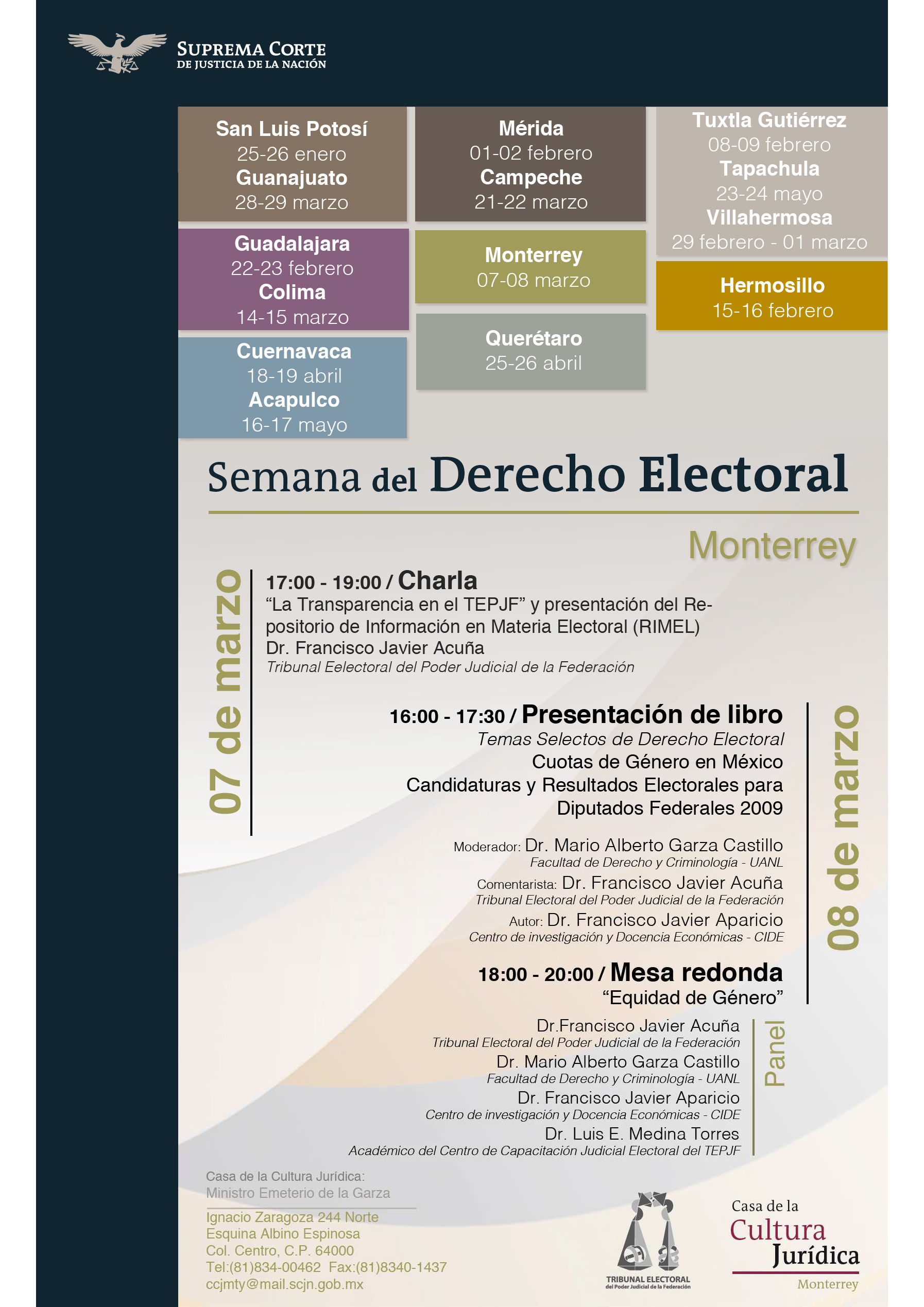
Melissa Dell en el CIDE

Este miércoles a la 1pm, la División de Estudios Políticos y la División de Economía del CIDE invitan al seminario:

Trafficking Networks and the Mexican Drug War (appendix), de Melissa Dell (MIT).

Abstract: Drug trade-related violence has escalated dramatically in Mexico during the past five years, claiming 40,000 lives and raising concerns about the capacity of the Mexican state to monopolize violence. This study examines how drug traffickers’ economic objectives influence the direct and spillover effects of Mexican policy towards the drug trade. By exploiting variation from close mayoral elections and a network model of drug trafficking, the study develops three sets of results. First, regression discontinuity estimates show that drug trade-related violence in a municipality increases substantially after the close election of a mayor from the conservative National Action Party (PAN), which has spearheaded the war on drug trafficking. This violence consists primarily of individuals involved in the drug trade killing each other. The empirical evidence suggests that the violence reflects rival traffickers’ attempts to wrest control of territories after crackdowns initiated by PAN mayors have challenged the incumbent criminals. Second, the study accurately predicts diversion of drug traffic following close PAN victories. It does this by estimating a model of equilibrium routes for trafficking drugs across the Mexican road network to the U.S. When drug traffic is diverted to other municipalities, drug trade-related violence in these municipalities increases. Moreover, female labor force participation and informal sector wages fall, corroborating qualitative evidence that traffickers extort informal sector producers. Finally, the study uses the trafficking model and estimated spillover effects to examine the allocation of law enforcement resources. Overall, the results demonstrate how traffickers’ economic objectives and constraints imposed by the routes network affect the policy outcomes of the Mexican Drug War.

Comentan: Eva Arceo (DE) y Brian Phillips (DEI)
Modera: Rosario Aguilar (DEP)
Fecha y lugar: 25 de abril de 2012, 1:00-2:30 pm, Sala CIB 1.

Aquí encontrarán más papers de Melissa Dell.
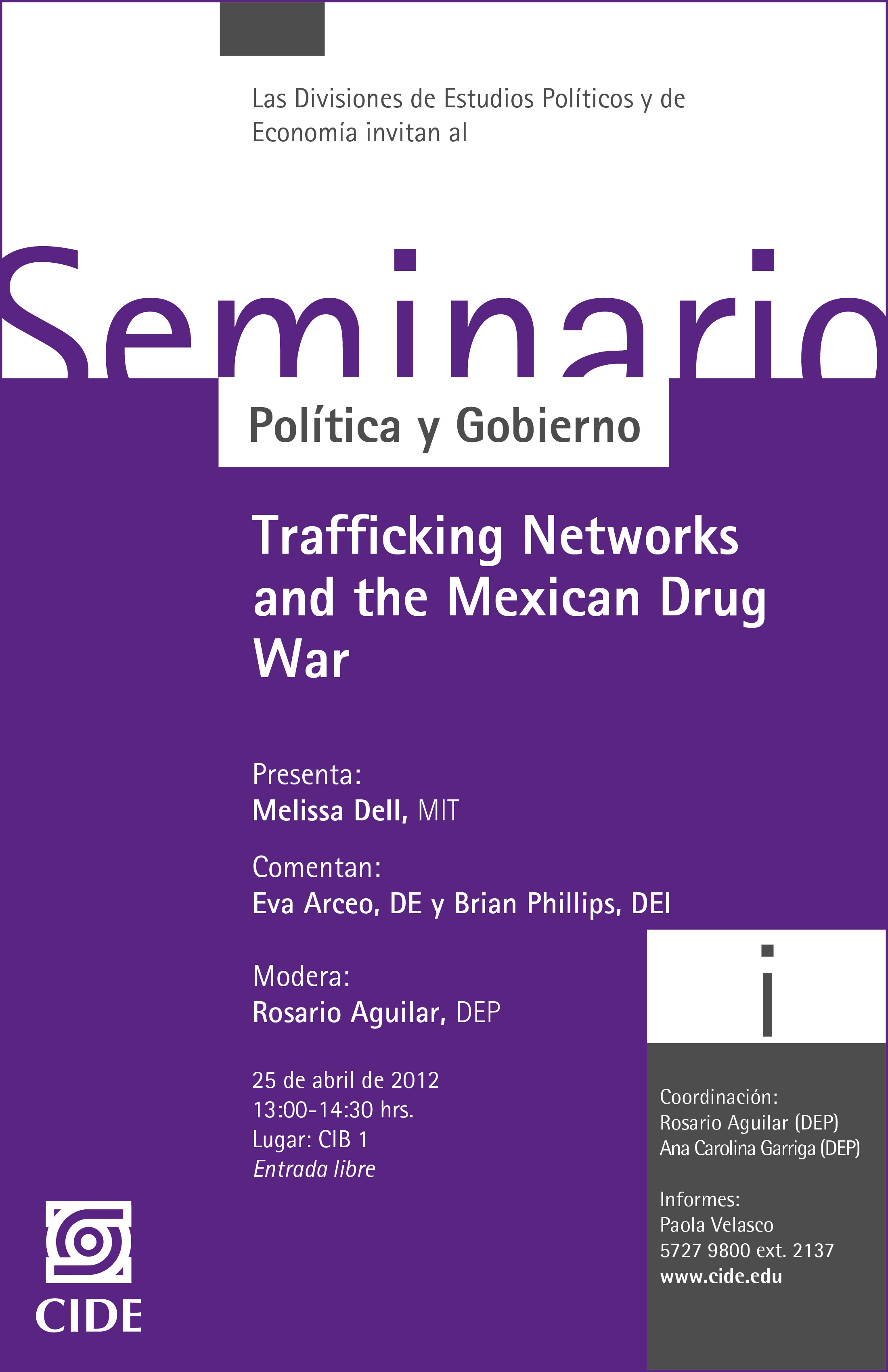
Semana de derecho electoral Monterrey

Hoy participaré en la semana de derecho electoral del TEPJF en la ciudad de Monterrey, Nuevo León, para presentar mi trabajo: “Cuotas de género en México: candidaturas y resultados electorales para diputados federales 2009Serie Temas selectos de derecho electoral, vol. 18, Tribunal Electoral del Poder Judicial de la Federación, 2011.


Mesa elecciones 2012

Aviso de última hora: los consejeros Lorenzo Córdova y Benito Nacif no podrán estar en el evento porque habrá sesión extraordinaria en el IFE a las 11am. Pero la mesa sobre encuestas sigue en pie.

El miércoles 8 de febrero de 2012, a las 11:30hrs, se realizará la primera “Mesa de discusión sobre Elecciones 2012” en el Auditorio Cuajimalpa del CIDE.

Mesa 1 ¿Es aplicable la ley electoral?

Ponenes: Benito Nacif, Lorenzo Córdova, Carlos Elizondo
Modera: María Amparo Casar

Presentación del Proyecto “Encuesta Nacional Electoral 2012” CIDE-IFE-Conacyt

Mesa 2 ¿ Son confiables las encuestas?
Ponentes: Roy Campos, Alejandro Moreno, Ulises Beltrán, Javier Aparicio
Modera: Jorge Buendía

Aquí podrán seguir la transmisión en línea.


Sesiones consejos distritales

Este sábado 28 de enero de 2012 se realizará la primera sesión ordinaria de los 300  consejos distritales del IFE en el país. En este archivo encontrarán los domicilios y el horario de las sesiones de los 27 consejos distritales del IFE en el DF. Todas las sesiones de los consejos locales y distritales son públicas.

Más información: ¿Qué hacen los consejos distritales y cómo funcionan?

#OcupaIFE en Animal Político

El día de hoy, animalpolítico publicó una detallada nota sobre la convocatoria para capacitadores electorales del IFE. Entre otras cosas, la nota incluye algunos antecedentes de la iniciativa #ocupaIFE:

Tomando como ejemplo los movimientos “Ocupa” que se esparcieron el año pasado, Aparicio -ayudado por otros tuiteros como @ppmerino– acuñó #OcupaIFE para mandar el mensaje de que “la participación ciudadana no sólo es manifestarte en la calle, plantarte, gritar y sacar un cartel, de suyo muy valioso y saludable” en una democracia, sino ocupar también los “espacios institucionales abiertos a la ciudadanía”. En particular, en este momento en que los ciudadanos no se sienten representados ni partícipes del sistema político, vale la pena atender las convocatorias del IFE donde se abren una gran cantidad de espacios para la participación ciudadana. El proceso electoral no sólo cuenta el Consejo General, sino que se instalan 32 consejos locales y 300 consejos distritales, los cuales a su vez se conforman de 7 consejeros cada uno.

El propósito de usar #OcupaIFE para Aparicio es transmitir la idea de que “el IFE es tan ciudadano como tú quieras: si participas, el IFE es más ciudadano y si no participas se vuelve más una institución burocrática.” En el proceso electoral los ciudadanos pueden desempeñar alguno de los muchos cargos que se abren, ya sea como consejero local o distrital, capacitador o supervisor electoral y como funcionario de casilla.

Aquí encontrarán la nota completa. Muchas gracias a animalpolítico y@dmorenochavez por el espacio y apoyar esta iniciativa.

On animals and institutions

This essay was originally published in 1928 by J. B. S. Haldane and today was featured in the Farnam Street blog.

On Being the Right Size

(…) And just as there is a best size for every animal, so the same is true for every human institution. In the Greek type of democracy all the citizens could listen to a series of orators and vote directly on questions of legislation. Hence their philosophers held that a small city was the largest possible democratic state. The English invention of representative government made a democratic nation possible, and the possibility was first realized in the United States, and later elsewhere. With the development of broadcasting it has once more become possible for every citizen to listen to the political views of representative orators, and the future may perhaps see the return of the national state to the Greek form of democracy. Even the referendum has been made possible only by the institution of daily newspapers.

To the biologist the problem of socialism appears largely as a problem of size. The extreme socialists desire to run every nation as a single business concern. I do not suppose that Henry Ford would find much difficulty in running Andorra or Luxembourg on a socialistic basis. He has already more men on his pay-roll than their population. It is conceivable that a syndicate of Fords, if we could find them, would make Belgium Ltd or Denmark Inc. pay their way. But while nationalization of certain industries is an obvious possibility in the largest of states, I find it no easier to picture a completely socialized British Empire or United States than an elephant turning somersaults or a hippopotamus jumping a hedge.

Para fortalecer la democracia hay que fortalecer la democracia

Para fortalecer la democracia hay que fortalecer la democracia–y no el autoritarismo. Parece una tautología trivial pero no lo es tanto. Przeworski et al. explican por qué.

Adam Przeworski, Michael Alvarez, José Antonio Cheibub & Fernando Limongi “What Makes Democracies Endure?“, Journal of Democracy 7.1 (1996) 39-55.

“If a country, any randomly selected country, is to have a democratic regime next year, what conditions should be present in that country and around the world this year? The answer is: democracy, affluence, growth with moderate inflation, declining inequality, a favorable international climate, and parliamentary institutions.

This answer is based on counting instances of survival and death of political regimes in 135 countries observed annually between 1950 and 1990 (…) for a total of 4,318 country-years.

Our definition of democracy is a minimalist one. We follow Robert A. Dahl’s 1971 classic Polyarchy in treating as democratic all regimes that hold elections in which the opposition has some chance of winning and taking office.

It may seem tautological to say that a country should have a democratic regime this year in order to have a democracy next year. We do so in order to dispel the myth, prevalent in certain intellectual and political circles (particularly in the United States) since the late 1950s, that the route to democracy is a circuitous one. The claim is that 1) dictatorships are better at generating economic development in poor countries, and that 2) once countries have developed, their dictatorial regimes will give way to democracy. To get to democracy, then, one had to support, or at least tolerate, dictatorships.

Both of the above propositions, however, are false:

1) While analyses of the impact of regimes on economic growth have generated divergent results, recent econometric evidence fails to uncover any clear regime effect. The average rate of investment is in fact slightly higher in poor democracies than in poor dictatorships; population growth is higher under dictatorships but labor productivity is lower; and investment is more efficiently allocated under democracies. Dictatorships are no more likely to generate economic growth than democracies.

2) Democracies are not produced by the development of dictatorships. If they were, the rate at which dictatorships make the transition to democracy would increase with the level of development: analyses of the survival prospects of dictatorships, however, indicate that this is not the case. Indeed, transitions to democracy are random with regard to the level of development: not a single transition to democracy can be predicted by the level of development alone.

Since poor dictatorships are no more likely to develop than poor democracies and since developed dictatorships are no more likely to become democracies than poor ones, dictatorships offer no advantage in attaining the dual goal of development and democracy. In order to strengthen democracy, we should strengthen democracy, not support dictatorships.”

Quote

“There are few men who would not feel much less zeal in the discharge of a duty when they were conscious that the advantages of the station with which it was connected must be relinquished at a determinate period, than when they were permitted to entertain a hope of obtaining, by meriting, a continuance of them.”–Alexander Hamilton, The Federalist #72, 1788.

Politics and language

“If you simplify your English, you are freed from the worst follies of orthodoxy (…) and when you make a stupid remark its stupidity will be obvious, even to yourself. Political language — and with variations this is true of all political parties, from Conservatives to Anarchists — is designed to make lies sound truthful and murder respectable, and to give an appearance of solidity to pure wind.” — George Orwell. Politics and the English language (1946). Via Carlos Bravo.

Third-party leadership?

This is Ezra Klein on third party candidates in the US. (This a follow up debate with Matt Miller).

Which problem does your third party solve?

“(…) Miller’s speech implies that what’s holding American politics back is that there are no candidates willing to give this speech, or hold these positions. That’s not accurate. What’s holding American politics back is a polarized Congress that has collapsed into gridlock. What’s holding American politics back is that the minority party understands that the quickest path back to power is undermining the majority party’s ability to govern. What’s holding American politics back is that voters want a government spending at about 23 or 24 percent of GDP but they want taxes around 18 percent of GDP, or maybe even a bit lower.

These types of third-party proposals tend to talk a lot about hard truths, tough choices and unpleasant realities. But in almost all cases, they skirt the hardest political truth of all, which is that politics is hard, often boring, work. We all want political change to come from one dramatic presidential campaign, where the president galvanizes the country with an Aaron Sorkin-esque speech and the barriers to change crumble before the force of an inspired population. That’s the most seductive political promise of all, because it promises that this will be easy, exciting and quick. It promises that it’ll be like the inspirational romp of Obama’s 2008 campaign rather than the tough slog of his subsequent presidency. It suggests that our problem is that we simply lack a leader, not that we lack the necessary consensus, institutions, and popular engagement required for change.

But lack of leadership is not our problem, or at least not our most important problem. Radical change doesn’t begin with the president and filter down. It begins at the bottom and filters up to the presidency.”

Plaza en CIDE-Aguascalientes

La División de Estudios Políticos del CIDE anuncia la siguiente plaza (convocatoria oficial DEP-AGS-2012. Convocatorias en otras divisiones. English version below.)

CONVOCATORIA PARA PLAZA DE PROFESOR INVESTIGADOR
CENTRO DE INVESTIGACIÓN Y DOCENCIA ECONÓMICAS
REGIÓN CENTRO – AGUASCALIENTES

La División de Estudios Políticos del Centro de Investigación y Docencia Económicas (CIDE) convoca al concurso por una plaza de profesor-investigador para formar parte de la facultad del CIDE Región Centro-Aguascalientes a comenzar en febrero o en agosto de 2012. El CIDE Región Centro es una nueva sede de nuestra institución pública de investigación y docencia en ciencias sociales especializada en gobierno y finanzas subnacionales. El candidato seleccionado deberá contar con el grado de doctor en ciencia política con especialización en política comparada y con una agenda de investigación en el campo de federalismo, gobiernos municipales, actores, partidos y política locales. La carga de docencia será de dos a tres cursos por año. El idioma de trabajo en el CIDE es el español. Se ofrece un salario en pesos mexicanos. Se recomienda a los interesados consultar la página www.cide.edu para obtener mayor información del CIDE Región Centro y de la División de Estudios Políticos. Los interesados deberán presentar los siguientes documentos: a) una carta en la que expliquen sus líneas de investigación, b) currículum vite, c) copia de sus calificaciones oficiales, d) tres cartas de recomendación, y e) copia de un artículo publicado o muestra de trabajo escrito. Toda correspondencia deberá dirigirse al: Dr. Julio Ríos Figueroa, Comité de Selección, División de Estudios Políticos, CIDE, email: ingreso.politicos@cide.edu. La recepción de solicitudes deberá ser por correspondencia electrónica y se cerrará el 10 de diciembre de 2011. Se prevé que las entrevistas se lleven a cabo durante el mes de enero de 2012.

Continue reading

Reelección legislativa y encuestas

Anoche el diputado Luis Videgaray esbozó en twitter el siguiente argumento en contra de la reelección: de acuerdo a numerosas encuestas, los mexicanos no apoyan la reelección legislativa y por ello no hay que “crucificar a los diputados que se oponen” a ella.

Una primera reacción es preguntarnos si el diseño constitucional en verdad debe seguir a las encuestas. Muchas encuestas indican que la gente no quiere a los partidos políticos ni les gusta pagar impuestos. ¿Los abolimos?

Pero una pregunta más importante es: ¿En verdad el PRI busca “proteger la voluntad ciudadana” al oponerse a la reelección o más bien buscan proteger a las cúpulas partidistas (beneficiarios directos de la no reelección) y acotar la rendición de cuentas ante el electorado? Continue reading