La economía política de “Las Aparicio”

He aquí una reflexión sobre el impacto de la serie “Las Aparicio“, cuya primera temporada culmina esta noche, en la cultura política nacional.

Al igual que los spots de campaña, el impacto de la telenovela “Las Aparicio” en la cultura nacional es cercano a cero (véase la literatura sobre “minimal media effects“). O quizá no. La verdad nunca vi un solo episodio pero varios conocidos y amistades inteligentes dicen que era una buena telenovela, así que le daría el beneficio de la duda. Lo que sí ocurrió es que la serie me produjo varias charlas de sobremesa del tipo:
–“Oye, ¿y la novela tiene algo que ver con tu familia?”
–“Un poco pero no puedo darte muchos detalles porque tenemos un acuerdo de confidencialidad con los productores.”

Pero esas divertidas charlas y el trending topic de #apariciotime terminan hoy. Qué lástima.

Aclaración: Esta entrada tiene el único propósito de aumentar el tráfico a mi blog de cibernautas confundidos que quizá piensen que aquí hay algo de información sobre su serie favorita. Lo lamento pero no, es sólo un vil truco de shameless blog-promotion. Pero no dejen de leer el capítulo de Ansolabehere “The Paradox of media effects” y coméntenlo con su legislador o consejero electoral de cabecera.

Seminario Encuestas y Elecciones en México

Este viernes y sábado (1 y 2 de octubre), el IFE organiza el 4o “Seminario de encuestas y elecciones en México 2009-2010”.  Es una interesante reunión de representantes de la industria de opinión pública nacional, académicos y funcionariosdel IFE mismo. Entre los temas a discutir se encuentran el papel de las encuestas públicas y privadas, así como su relación con los medios. Otros temas incluyen modelos del votante, push polls y, faltaba más, la regulación de las encuestas. Aquí pueden ver el programa.

Un tema reiterado en la reunión son los deseos de los encuestadores por autorregularse, y los de la autoridades electorales por regular un poquitito más. Este es el reporte del evento que Alejandro Moreno y Pablo Parás hicieron para WAPOR.

Narcotráfico y migración

Editorial del New York Times, publicado el 29 de agosto de 2010, sobre la relación entre el narco y tráfico de personas, los dos mercados negros que se entrecruzan en la frontera.

Massacre in Tamaulipas

The full story of the massacre in Tamaulipas, in northeast Mexico, awaits telling by its one survivor. The early news accounts are horrifying: 72 people, said to be migrants from Central and South America on their way to the United States, are waylaid and imprisoned by drug smugglers on a ranch 100 miles south of Texas. They refuse to pay extortion fees and are executed. The survivor, shot in the neck, hears their screams for mercy as he flees. After a gun battle with the authorities, the killers escape in S.U.V.’s. The dead, 58 men and 14 women, are found piled in a room, discarded contraband. Continue reading

Ley Arizona y los republicanos

Este es un comentario al vuelo sobre la “Ley Arizona” SB1070, publicado en El Universal del 3 de agosto de 2010.

El fallo de Arizona

Unas horas antes de que entrara en vigor la ley SB1070 de Arizona, la jueza federal Susan Bolton bloqueó sus aspectos más controversiales: la policía estatal no podrá verificar el estatus migratorio de personas detenidas por otras razones, ni se podrá criminalizar el no portar documentos migratorios en todo momento o buscar empleo en lugares públicos—obligaciones que pondrían una carga desmedida entre los inmigrantes y residentes legales. Esta historia aún no termina puesto que la gobernadora Jan Brewer apeló la decisión de inmediato y es muy probable que el caso llegue hasta la Suprema Corte. De hecho, más de 10 estados consideran ahora mismo iniciativas de ley similares. Continue reading

Top 15 al cumplir un año

Inicié este blog hace poco más de 5 años en blogspot, y apenas hace un par de semanas cumplió un año en wordpress.  Estos son las 15 más notas consultadas en los últimos 12 meses, según los tracking stats de wordpress. Dejando de lado la página de métodos, hay demasiada polaca y escasa economía: quizá debería considerar cambiar el nombre del blog. Quizá todo es culpa de la reforma política (que nunca llegará). Ya veremos.

ITEM # Hits
Home page 2,400
Métodos 476
Solicitud de Visa para Canadá 420
Verano 2009 401
Sobre el subsidio a partidos políticos 273
Reforma política, sistema electoral y Congreso 228
Función de utilidad 208
Opinión Pública y Análisis de Encuestas: 183
About 178
Presupuesto IFE + Partidos Políticos 152
Elección 2009: primeras reacciones 143
Género y la elección 2009 143
Research 128
Reducción de plurinominales 116
Seminario Reforma Política 87

Opinión Pública y Análisis de Encuestas: Curso corto

Como parte de los Cursos Internacionales de Verano del CIDE, David Crow y un servidor impartiremos un curso corto sobre “Opinión Pública y Análisis de Encuestas”. El curso tendrá una duración de16 horas y será impartido del 6 al 9 de julio de 16 a 20:00 hrs. en las instalaciones del CIDE. El temario preliminar se encuentra aquí. Para mayores detalles sobre el costo y procedimientos de inscripción, consulten esta página.

Objetivos del curso:

En este curso se analizarán, por un lado, algunos enfoques teóricos de la opinión pública, particularmente actitudes y comportamientos políticos tales como formación de preferencias, identidades partidistas, pronósticos electorales y votantes probables.  Por otro lado, se presentarán diversos enfoques metodológicos para la elaboración y el análisis de encuestas: teoría y práctica de muestreo, fuentes de error en encuestas, análisis de encuestas complejas y modelos de regresion para variables discretas o limitadas.

El curso enfatizará la aplicación práctica de estos métodos analizando encuestas de diferente tipo con paquetes estadísticos como Stata o R. Este curso está dirigido a estudiantes y practicantes de la investigación social tanto del sector público como del privado. Contar con experiencia previa en métodos cuantitativos no es indispensable pero sí recomendable para un mejor aprovechamiento del curso.

Earth at night

In case you have not been paying attention, I changed the layout of my blog a few days ago.  The picture that I use in the header can be found here, and this is the corresponding  explanation from NASA:

This is what the Earth looks like at night. Can you find your favorite country or city? Surprisingly, city lights make this task quite possible. Human-made lights highlight particularly developed or populated areas of the Earth’s surface, including the seaboards of Europe, the eastern United States, and Japan. Many large cities are located near rivers or oceans so that they can exchange goods cheaply by boat. Particularly dark areas include the central parts of South America, Africa, Asia, and Australia. The above image is actually a composite of hundreds of pictures made by the orbiting DMSP satellites.

Evidently, electricity is important and oftentimes it is used as a proxy for economic production when reliable data is not available. Electricity also tracks economic development rather nicely. So, if you ever wondered whether the western/capitalistic world really faced a threat from former socialist countries, just look at the picture one more time: empirical observation beats ideology, anytime :)

Competition and media bias

There is a growing literature on media bias and, more generally, on how does the so called  marketplace of ideas really work. By far, this is not a new topic but it is only recently that mainstream economists became interested in the topic. Matthew Gentzkow and Jesse M. Shapiro make a very clear and comprehensive introduction to this literature in their article: “Competition and Truth in the Market for News” (Journal of Economic Perspectives 22(2), Spring 2008). The piece has a number of interesting quotations:

[T]he best test of truth is the power of the thought to get itself accepted in the competition of the market . . . That at least is the theory of our Constitution. — Oliver Wendell Holmes, Abrams v. United States (250 U.S. 616 [1919])

The press was protected so that it could bare the secrets of government and inform the people. Only a free and unrestrained press can effectively expose deception in government. — Hugo Black, New York Times Co. v. United States (403 U.S. 713 [1971]) Continue reading

Clase media en México

El domingo pasado Thomas Friedman dedicó su columna del New York Times a caracterizar tres grupos sociales que, según él, definen a Mexico hoy día: los narcos, los “No’s” (léase, clase media rentista) y los NAFTA (léase, clase media meritocrática). Los comentarios de Friedman se inspiran y complementan con el artículo de Luis de la Calle y Luis Rubio sobre clasemedieros en México, publicado en Nexos de mayo 2010.

May 2, 2010

Narcos, No’s and Nafta

Mexico City

(…) We take the Mexican-American relationship for granted. But with the drug wars in Mexico turning into Wild West shootouts on city streets and with our own immigration politics turning more heated, what’s happening in Mexico has become much more critical to American foreign policy and merits more of our attention. Mexico is not Afghanistan, but it also has not become all that it hoped to be by now. Something feels stalled here.

Three groups are now wrestling to shape Mexico’s future. I’d call them “the Narcos,” “the No’s” and “the Naftas.” Root for the Naftas. Continue reading

Natural experiments in history

An interesting post from Nicolas Baumard (with a great quote on large N vs. small n studies):

On the Use of Natural Experiments in Anthropology

Jared Diamond and Harvard Economist James Robinson have just edited a book on Natural experiments in history. This book reviews eight comparative studies drawn from history, archaeology, economics, economic history, geography, and political science. The studies cover a spectrum of approaches, ranging from a non-quantitative narrative style in the early chapters to quantitative statistical analyses in the later chapters. (…) The conclusion of the book struck me, as I had the feeling that it could have been written for students of culture.

Every field of scholarship, not just human history, experiences tension between narrowly focused case studies and broader synthesis or generalization. Practitioners of the case study method tend to decry syntheses as superficial, coarse-grained, and absurdly oversimplified; practitioners of syntheses tend to decry the case studies as merely descriptive, devoid of explanatory power, and unable to illuminate anything except one particular case study. Eventually, scholars in mature fields come to realize that scholarly understanding required both approaches. Without reliable case studies, generalists have nothing to synthesize; without sound syntheses, specialist lack a framework within which to place their case studies. (…) Continue reading

Immigrants and their Homelands

This friday, Covadonga Meseguer and I are attending an all day workshop at UCLA.  This is the program:

“Immigrants and their Homelands: Engagements, Impacts, Responses”

UCLA,  April 30th 2010

PANEL I

Leticia Calderón Chelius (Instituto Mora) “Uses and abuses of the social construction of the Mexican diaspora”
Lauren Duquette (Chicago) “Migrant Collective Remittances: Transforming Public Works, Local Governance, and State-Society Relations in Mexico”
Natasha Iskander (NYU) “Moroccan migrants as captains of industry: Remittances, Financial Engagement, and La Banque Centrale Populaire”
Jean-Michel Lafleur (University of Liege) “Bolivia’s first experience of external voting: comparing the profile of emigrant voters in New York, Sao Paulo, Buenos Aires and Madrid”

Commentator: David Fitzgerald (UCSD)

PANEL II

Katrina Burgess (Tufts) “Migrant Associations and Democratic Accountability in Mexico”
Clarisa Perez-Armendariz (Bates College) “Trans-state communication and political learning”
Roger Waldinger (UCLA)  “The Limits of Engagement: Mexico and its Diaspora”

Commentator: Roberto Suro (USC)

PANEL III

Jeronimo Cortina (Houston), “Beyond the Money: The Impact of International Migration on Children’s Life Satisfaction – An Initial Assessment”
Jonathan Hiskey (Vanderbilt) “Migration Connections and Democracy in Latin America”
Covadonga Meseguer and Javier Aparicio (CIDE) “The Political Economy of Collective Remittances: The Mexican 3×1  Program for Migrants”

Commentator: Jorge Bravo (UCLA)

Chicago / MPSA 2010

This weekend I will be attending the Midwest Political Science Association Conference, in Chicago 22-25 April, 2010. You can find the program and some papers here. These are the abstracts of the papers that we will deliver at the conference.

Subsidized democracy? The effect of public funding to political parties in electoral competitiveness

Javier Aparicio and Jacaranda Pérez (IFE)

[Session 22-19 Comparative Electoral Analysis. Saturday, April 24 10:25 am]

Public funding to political parties has been adopted in a large number of democracies over the last several decades. Public funding seeks two major goals: 1) to level the playing field in electoral races, which should make elections more competitive; and 2) to reduce the entry costs for new political parties, which should enhance the representativeness of the electoral system.  However, there is scant evidence on whether or not any of these objectives are actually achieved. Using a panel dataset of national elections in OECD countries over the 1945 to 2008 period, we estimate the effect of public funding on the competitiveness of both parliamentary and presidential elections.  Our results indicate that public funding is associated with narrower margins of victory and a larger effective number of political parties.  On the other hand, public funding may be associated with lower turnout levels.

The Mexican Supreme Court: Judicial Activism in New Constitutional Courts

Jenny Guardado (NYU) and Javier Aparicio

[Session 3-24 Political Institutions in Contemporary Mexico. Saturday, April 24 12:45 pm]

Under what conditions do newly established constitutional courts exercise their judicial review powers? Recent studies of judicial decision-making have ignored the political process leading to the ling of a case, which creates sample selection problems: Are constitutional courts more active because they receive more cases that are “likely to succeed”, or because the political conditions of each case have a role in the court’s final rulings? We address this issue by exploiting the longitudinal variation in a novel dataset of all constitutional cases presented by sub-national actors to the Mexican Supreme Court from 1995 to 2005. We use sample selection and propensity score matching models to estimate the likelihood of a positive ruling from the court, conditional on the factors that led to the filing of a case in the first place. Our results indicate that sub-national political pluralism is associated with a higher likelihood of judicial activity. Specifically, the Court’s rulings are more likely to change the status-quo when political fragmentation or competition is higher. Moreover, we find that this effect varies depending on the likelihood of presenting a case. Finally, we find that the partisanship of the actors involved have a lesser impact.

Reforma política, sistema electoral y Congreso

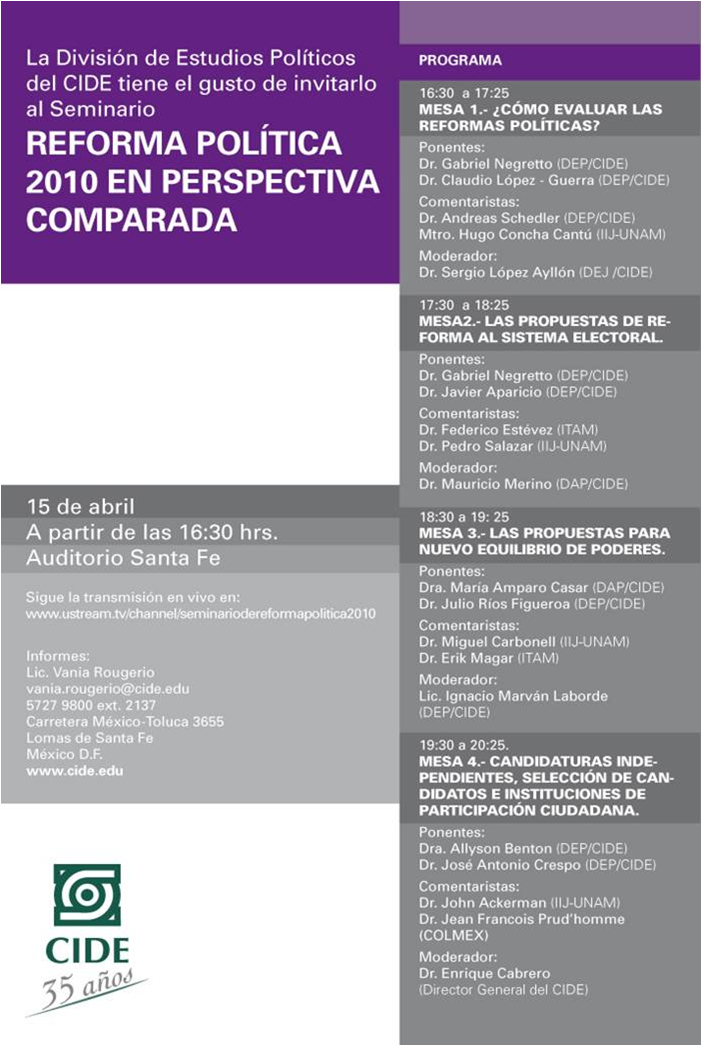
Esta es la presentación powerpoint del trabajo que Javier Márquez y yo preparamos para el Seminario “Reforma Política en Perspectiva Comparada” organizado por el CIDE el 15 de abril pasado. El seminario fue transmitido online y pueden verlo aquí (mi intervención comienza en el minuto 1:34 y dura 15 minutos).

Nuestra ponencia fue sobre: “Reforma política y sistema electoral: tamaño del congreso, redistritación y umbral de representación en México”. El texto aún está en proceso pero podemos adelantar algunas de las conclusiones:

  1. Una reducción de 100 curules RP tiene efectos marginales en el tamaño relativo de las bancadas.
  2. La redistritación MR puede tener efectos significativamente mayores: alteraría tanto el sesgo mayoritario como el sesgo partidista del sistema.
  3. El sesgo mayoritario de la Cámara se debe, sobre todo, a que no existe un mecanismo compensatorio: las curules RP se asignan independientemente del éxito o fracaso en la pista MR.
  4. El tope de sobrerrepresentación produce efectos no lineales en la asignación de curules: más votos no necesariamente se traducen en más curules (y viceversa).
  5. Un esquema RP con listas estatales de diferente magnitud introduciría un sesgo mayoritario en las bancadas estatales (inversamente proporcional a su población).
  6. Aumentar el umbral de representación aumenta el sesgo mayoritario del sistema electoral y disminuye el número efectivo de partidos en el Congreso. Pero beneficia a todo partido que haya sido penalizado por el tope de sobrerrepresentación.

Y algunas alternativas que podrían considerarse son:

  1. Al igual que el tope de sobrerrepresentación, una “claúsula de gobernabilidad” produce efectos no lineales: otorga más curules de las obtenidas con votos y castiga al resto de los partidos. Este tipo de esquemas son raramente vistos en el mundo.
  2. El sistema electoral podría ser igual o más proporcional que ahora si:
  • Aumenta el número de distritos MR (menor tamaño de distrito produce más proporcionalidad).
  • Aumenta el número de curules RP con listas de magnitud suficientemente  grande.
  • Se introduce un “mecanismo compensatorio” en la asignación de curules RP: si un partido tiene mucho éxito en la pista MR, recibe menos curules RP, y viceversa.
  • Se permite una boleta para MR y otra para RP, de modo que el split ticket voting disminuya la sobrerrepresentación del partido con mayoría relativa.