Programa 3×1 para Migrantes

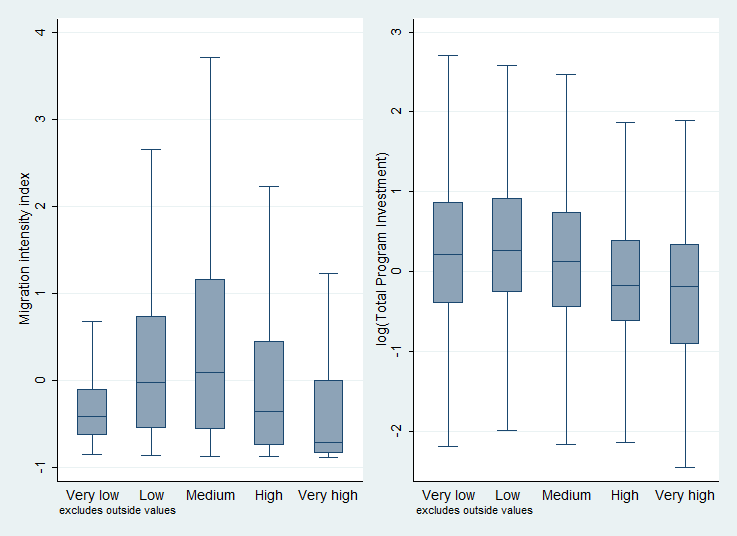
La migración y la pobreza tienen una relación no lineal: los muy pobres no pueden sortear los costos de migrar y los ricos no quieren migrar.  El panel izquierdo de este box plot ilustra los niveles de intensidad migratoria de los municipios mexicanos para cada grado de marginación (desde muy baja hasta muy alta marginación). El índice de intensidad migratoria corresponde a 2002 y la marginación es de 2005, ambos de CONAPO.

El rectángulo sólido de cada boxplot ilustra el percentil 25, 50 (mediana) y 75 de cada grupo de observaciones. Como se aprecia, la intensidad migratoria mediana es mayor en los municipios de marginación media y es allí donde, además, tiene mayor varianza.  Por otro lado, la menor intensidad migratoria está en los municipios de alta y muy alta marginación.

Continue reading

La moralidad de conservadores y liberales

Jonathan Haidt, profesor de psicología  de la Universidad de Virginia, estudia las cinco factores morales subyacentes a eso que llamamos ideología.Vale la pena escucharlo antes de desgarrarse vestiduras (una vez más) ante la perversidad y necedad de “derechosos” e “izquierdosos”.

Jonathan Haidt on the moral roots of liberals and conservatives

Otros temas relacionados:

Sobre la fijación en “el enemigo” como mecanismo de defensa http://bit.ly/d1hd9U

Are Conservatives Happier Than Liberals?: http://su.pr/1KY3ql

The secret lives of liberals and conservatives http://bit.ly/cm5rMq

IQ, religiosidad e ideología http://bit.ly/bOILge

Life is a fountain

This is David Schmidtz on The Meanings of Life

In Philosophical Explanations, Nozick says the question of life’s meaning is so important to us and leaves us feeling so vulnerable that,

we camouflage our vulnerability with jokes about seeking for the meaning or purpose of life: A person travels for many days to the Himalayas to seek the word of an Indian holy man meditating in an isolated cave. Tired from his journey, but eager and expectant that his quest is about to reach fulfillment, he asks the sage, “What is the meaning of life?” After a long pause, the sage opens his eyes and says, “Life is a fountain.” “What do you mean life is a fountain?” barks the questioner. “I have just traveled thousands of miles to hear your words, and all you have to tell me is that? That’s ridiculous.” The sage then looks up from the floor of the cave and says, “You mean it’s not a fountain?”

In a variant of the story, he replies, “So it’s not a fountain.” The sage feels none of the angst that led the seeker to the cave. So, who’s missing something: sage or seeker? The story suggests a contrast of attitudes. I’ll call them Existentialist and Zen, meaning only to gesture at the traditions these names evoke. The Existentialist attitude is that life’s meaning, or lack thereof, is of momentous import. We seek meaning. If we don’t get it, we choose between stoicism and despair. The Zen attitude is that meaning isn’t something to be sought. Meaning comes to us, or not. If it comes, we accept it. If not, we accept that too. To some degree, we choose how much meaning we need. Perhaps the sage achieves peace by learning not to need meaning. Perhaps that’s what we’re meant to learn from the sage’s seemingly meaningless remark that life is a fountain.

The Existentialist insight, in part, is that meaning is something we give to life. We do not find meaning so much as throw ourselves at it. The Zen insight, in part, is that worrying about meaning may itself make life less meaningful than it might have been. Part of the virtue of the Zen attitude lies in learning to not need to be busy: learning there is joy and meaning and peace in simply being mindful, not needing to change or be changed. Let the moment mean what it will.

Reforma política

He aquí una breve colección de mis tweets sobre reforma política de los últimos días (tomados de diferentes puntos de mi timeline en twitter y con algunas ediciones):

REFORMA POLITICA

  1. Varios papers sobre reforma política: http://investigadores.cide.edu/aparicio/refpol
  2. Al parecer hay que reformar la constitución para que sea más fácil seguirla reformando. ¿Cuándo tendremos una constitución de verdad?
  3. Haggard/McCubbins 101: Decisiveness = ability to change policy. Resoluteness = ability to commit to a given policy.
  4. Haggard/McCubbins Trade off#1: A more decisive polity must necessarily be less resolute.
  5. Haggard/McCubbins Trade off#2: As the effective number of veto players increases, the polity becomes more resolute and less decisive.
  6. El decálogo de reforma politica tiene prob<10% de ser aprobado en general. Ciertos items tienen p<30%. I’ll update this prior on the 29th.
  7. Y de las 10 propuestas reforma politica, me gustan unas 6 o 7. Necesito hacer un ranking pero reelección va 1er lugar.
  8. La reelección haría más “representativo y más fuerte” al Congreso. Por ello el Ejecutivo necesitaría más “poderes legislativos” para negociar su agenda.

Continue reading

Education, job training and productivity

Bryan Caplan, over at EconLog, cites an interesting discussion on the role of education and productivity, as featured in Arnold King and Nick Schulz recent book From Poverty to Prosperity. The authors interview William Lewis:

AK & NS: One finding that might surprise some people is that the education level of the labor force isn’t nearly as important for the overall economic performance of a nation as commonly thought… How did you reach that conclusion?

William Lewis: … [W]e got the first hint of this when we were studying Japan back in the early 1990s…  There were many disparaging comments made in the U.S., and maybe even stronger ones made abroad (especially in Japan), about how the U.S. labor force was getting what it deserved because it was lazy, uneducated, and maybe even dumb.  But of course, the Japanese – the capable, competent Japanese manufacturing companies – showed that this notion was wrong by coming here, building their own factories, managing American labor, and taking a lot of other local inputs and coming within five percent of reproducing their home country productivity.
[…]
The great bulk of the evidence about education came from competent multinational corporations of any nationality, who showed that they could go virtually anywhere in the world and take the local workforce and train it to come close to home country productivity.  The clinching evidence [came when] we looked at some other industries.  We compared the construction industry in the U.S. with construction in Brazil and found that in Houston, the U.S. industry was using Mexican agriculture workers who were illiterate and didn’t speak English.  They were not any different than the agricultural workers who were building similar high rises in Sao Paolo, say.  And yet they were working at four times the productivity.
Uneducated people can be trained on the job to accomplish quite high skill levels and quite high levels of productivity.  And that’s good news, because if the World Bank and everybody else had to wait until we revamped the educational institutions of all of the poor countries and then put a cohort or two of workers through it, we are talking about another fifty years before anything happens.  That’s not acceptable and it’s not necessary, thank God.

Twitter forever?

From The New York Times (1-jan-2010):

Why Twitter will endure

“What could anyone possibly find useful in this cacophony of short-burst communication?

Well, that depends on whom you ask, but more importantly whom you follow. On Twitter, anyone may follow anyone, but there is very little expectation of reciprocity. By carefully curating the people you follow, Twitter becomes an always-on data stream from really bright people in their respective fields, whose tweets are often full of links to incredibly vital, timely information.

Like many newbies on Twitter, I vastly overestimated the importance of broadcasting on Twitter and after a while, I realized that I was not Moses and neither Twitter nor its users were wondering what I thought. Nearly a year in, I’ve come to understand that the real value of the service is listening to a wired collective voice.”

I guess that means that all of us should keep typing one-liners to give twitter critical mass and, eventually, more substance: nobody really cares, but that is the point!

Micro vs. macro: What works in development?

This is from The Brookings Institution–(check the links to the conference papers below!)  The conference brought together a great group of micro and macroeconomists.

What Works in Development? Thinking Big and Thinking Small

Bill Easterly and Jessica Cohen of Brookings recently convened a conference with leading development experts to explore one of the most vexing issues of global development: what do we really know about what works and what doesn’t when fighting global poverty? The conference focused on the ongoing debate over which paths to development really maximize results: a big-picture approach focusing on the role of institutions, macroeconomic policies, growth strategies and other country-level factors; or a more grassroots approach focusing on particular microeconomic interventions such as conditional cash transfers, bed nets, teaching materials and other micro-level improvements in service delivery on the ground.

CONFERENCE PAPERS:

Normative vs. positive models

In a very interesting piece on the fallacy of taking “the normative model of education as a true positive model” (NAP), Lant Pritchett cites Pigou:

“It is not sufficient to contrast the imperfect adjustments of unfettered enterprise with the best adjustment economists in their studies can imagine. For we cannot expect that any State authority will attain, or will even wholeheartedly seek, that ideal. Such authorities are liable alike to ignorance, to sectional pressure, and the personal corruption by private interest.”

The whole piece is here:

The Policy Irrelevance of the Economics of Education: Is ‘Normative as Positive’ Just Useless, or is it Worse?
Lant Pritchett (Harvard University, Kennedy School of Government).

Vote buying, pork barrel & district geography in the US

If you think vote buying/pork-barrel politics can only be studied in developing countries or young democracies, think again. This is precisely the research agenda of Jowei Chen, a young professor at the University of Michigan.  I met him in APSA 2009 and, as you can see, it is really great stuff (the following links are from his own website):

1. Vote Buying in United States Elections:

FEMA hurricane disaster aid increases Bush votes among core Republicans, but not among Democrats or nonpartisans. FEMA also awards disproportionately more aid to Republican applicants, even conditioning on hurricane severity. Full Abstract.
Government monetary awards converted poor voters into Bush supporters in November 2004. Full Abstract

2. The Geographic Targeting of Pork Barrel Projects:

American Political Science Review. Vol. 101, No. 4: p. 657-676. Abstract
Forthcoming, American Journal of Political Science. Vol. 54, No. 2. Abstract

3. The Electoral Geography of Legislative Districting:

We conduct legislative districting simulations using only the apolitical criteria of drawing compact and contiguous districts. We show that the Republican party naturally wins a disproportionately large share of legislative seats in Florida, even without gerrymandering. This result emerges because Democratic voters tend to live in highly concentrated, urban cores, thus “wasting” their electoral strength on a small number of landslide Democratic districts. Republican voters are geographically dispersed more evenly throughout the hinterlands, allowing the Republican party to win a disproportionate share of districts by a slight margin.

Debating fallacies

En Estados Unidos se discute una reforma al sistema de salud con serias implicaciones para el déficit público en el largo plazo.  Es un debate complicado, pero Tyler Cowen enfatiza varios problemas de la forma en que debaten algunos defensores de la reforma. Problemas de argumentación de este tipo son recurrentes en otros temas distributivos en diversas latitudes y por eso quiero retomarlos aquí:

The fact that Republicans can (correctly) be blamed for making the bill worse does not constitute an argument that the current bill will make things, in fiscal terms, better.

Citing inconsistencies of bill opponents (“but he didn’t scream loud enough about [fill in the blank] way back when”) does not help on this score either.

Another argument I have seen (…) is: If we can’t solve this health care costs problem it won’t matter, therefore we can spend more without making the problem in net terms worse.  That’s a fallacy and you would never apply such reasoning while driving over the speed limit (“I’ll accelerate right now, after all at some point I’ve got to slow down anyway.”)Here is a guide for identifying future arguments in these veins, because they will recur when you have an activist government which wants to be very popular, combined with an under-educated, short-term oriented citizenry:

1. The retreat into the relative: “All the other options are even worse.”

2. Blame the Republicans: “They made the bill bad, not us.”

3. The critic is evil or inconsistent: “Your views are inconsistent, or you are morally questionable, so I can dismiss your worries.”

How to rank countries in a snap

Douglas Muir, from A Fistful of Euros, comments on country indexes (transparency, governance, freedom, etc.)countries.  As they say, perhaps it’s funny because it’s true!

Everyone must move to Finland right now

“What’s interesting is how almost all of these indexes, good and crappy alike, follow the same general pattern: First World countries filling up the top ranks, former colonies — especially in Africa — at the bottom. I bet you could generate a very plausible looking index with just a handful of simple rules. Negative numbers are depressing, so everybody starts with 20 points:

+10 If you are in Europe
+6 If you are in North (not Central) America
-10 If you are in Africa
-3 if you touch the Equator
+3 if you are largely north or south of 45 degrees latitude
+1 more if you are entirely so
+1 if you are a small (<100,000 square km) country
+1 more if you are tiny (<5,000 square km)
-5 if you are landlocked
+2 if your country existed 50 years ago
+5 if you are a former colony populated mostly by people of European descent
-1 if you’re mostly Muslim

Ingresos y Presupuesto 2010

Mi opinión sobre el paquete económico (ingresos y presupuesto) para 2010 aparece en El Universal de hoy (quizá añada un poco más de información más tarde).

Los costos de la hacienda

La discusión y aprobación tanto de los ingresos como del presupuesto de egresos del gobierno federal tiene una naturaleza eminentemente distributiva: produce ganadores y perdedores. A diferencia de otros asuntos que se posponen indefinidamente en el congreso, el debate anual en torno al presupuesto permite analizar como pocos la negociación entre el presidente y los legisladores. Más allá de la retórica donde todos dicen preocuparse por el bien del país, las decisiones hacendarias nos revelan las preferencias de nuestra clase política o los intereses que representa.

En México, los ingresos tributarios han sido históricamente bajos (alrededor de 10% del PIB), comparados con los promedios regionales y de países con ingresos per cápita similares.  La baja recaudación –y su dependencia de una renta petrolera volátil y no renovable– restringe la capacidad del estado, además de reflejar un equilibrio político perverso.  Por décadas, la renta petrolera ha permitido posponer una reforma fiscal “integral”. Y si el gobierno puede gastar sin exigir impuestos, los ciudadanos se acostumbran a recibir bienes y servicios públicos sin contribuir o sin reclamar demasiadas cuentas por ellos.

En otras latitudes, las izquierdas demandan mayores impuestos y gasto público, mientras que los partidos de derecha exigen una menor intervención del estado en la economía. Pero en México vivimos en un mundo al revés: el gobierno federal, supuestamente de derecha, propone mayores impuestos para preservar el gasto social mientras que la oposición rebate que es una mala idea aumentar impuestos durante una recesión. Pero los matices ideológicos en el debate hacendario resultan inútiles cuando la evasión fiscal y el dispendio públicos son la norma.

Para tener claro quién gana y quién pierde con el statu quo hace falta una discusión seria sobre la incidencia de los impuestos y el gasto público en México. Por un lado, se equivocan quienes se oponen a establecer un IVA generalizado aduciendo proteger a los más pobres: alrededor de la mitad del subsidio implícito en la exención del IVA a alimentos y medicinas favorece al 20% más rico de la población. Por otro lado, si bien el gasto social ha aumentado en los últimos 15 años, se equivocan también quienes afirman que este gasto, en su forma actual, contribuye a reducir la desigualdad: programas como Oportunidades son bastante progresivos, pero el grueso del gasto redistributivo (educación, salud, pensiones, subsidios agrícolas) es regresivo en términos absolutos, es decir, tiende a beneficiar a los menos pobres. Y ni hablar de la calidad del gasto.

De acuerdo con el Presupuesto de Egresos aprobado esta semana, el gobierno federal espera erogar este año 3.18 billones de pesos–casi 30 mil pesos por habitante. Y se ha dicho hasta el cansancio que cualquier ajuste brusco al presupuesto pondría en riesgo importantes y exitosos programas sociales como Oportunidades. Pero, ¿de qué tamaño es el compromiso con el combate a la pobreza? La propuesta inicial del Presupuesto de Egresos de la Federación contemplaba alrededor de 84.2 mmdp para SEDESOL, de los cuales 38.8 mmdp irían a Oportunidades, es decir, sólo 1.2% de los ingresos totales para 2010. ¿A dónde se va el resto?

El gasto en inversión física se estima en 536.7 mmdp y las transferencias a entidades en 920 mmdp. En contraste, los servicios personales del gasto programable ascenderían a 829 mmdp (26% de los ingresos). Sea cual fuere la rentabilidad social del gasto en burocracia, difícilmente puede considerarse un gasto progresivo.

El crecimiento económico es el mejor remedio contra la pobreza, pero la necesaria provisión de bienes públicos y redistribución del ingreso corresponden al estado. Sin embargo, por muy diversas razones las democracias tienden a favorecer políticas públicas económicamente ineficientes en aras de sostener coaliciones políticas de distinta índole. Nuestro sistema político es aún más proclive a proteger a grupos empresariales del pago de impuestos, y a beneficiar con el gasto a grandes burocracias antes que a la mayoría de los ciudadanos. En gran medida, la ineficiencia e injusticia de nuestra hacienda pública es legado del corporativismo del régimen priísta, pero 12 años de gobiernos sin mayoría en el congreso, y 9 del PAN, hacen corresponsables ya al resto de nuestros representantes. Y si no entendemos por qué las reglas del juego favorecen esto, podemos esperar sentados a que la democracia produzca resultados distintos.

Simple rules

…for getting published:

Rule 1: Read many papers, and learn from both the good and the bad work of others.

Rule 5: Learn to live with rejection.

Rule 6. The ingredients of good science are obvious—novelty of research topic, comprehensive coverage of the relevant literature, good data, good analysis including strong statistical support, and a thought-provoking discussion. The ingredients of good science reporting are obvious—good organization, the appropriate use of tables and figures, the right length, writing to the intended audience—do not ignore the obvious.

Evidently, following these simple or obvious rules is not always easy…
More rules here (on research, teaching, academia vs. industry, etc.)